Synesso MVP’s brew gauge “normal” spans three conditions
What this article adds
Synesso MVP & MVP Hydra Technical Manual Version 2020.1 prints three different “normal” bands for the same brew-pressure gauge — line ~3–5 bar, brew 9 bar (with 8.5–9 and 8–9.5 variants in fault text), and heat-expansion 11–12 / 12 bar — while a manufacturer service note treats idle 11–12 bar as normal; the expansion valve is also printed once as a 12 bar release point and once as factory 11–12 bar.
Synesso’s MVP manuals put a brew-pressure gauge next to the group and then attach several different “normal” numbers to it. A reader who treats those numbers as one diagnostic answer will find the same instrument described as usually reading about 3–5 bar, as reflecting 9 bar while brewing, and as relieving at 11–12 bar when the brew tanks heat. A manufacturer technical-service note goes further and says it is normal to read 11.0 to 12.0 bar when the machine is at idle.
The useful separation is between those condition-specific bands for one gauge, plus a soft internal split on how the expansion valve’s bleed point is printed. It is not a service procedure, not a ranking of MVP against Hydra, and not a claim about what pressure reaches the coffee bed.
Source technical manual
Source document: Synesso MVP & MVP Hydra Technical Manual, Version 2020.1, cover label “Last update: September 2020” (PDF metadata creation date 2 October 2020). The file covers both MVP and MVP Hydra hardware. Claims below are scoped to that file unless a second source is named.
Three bands on one brew gauge
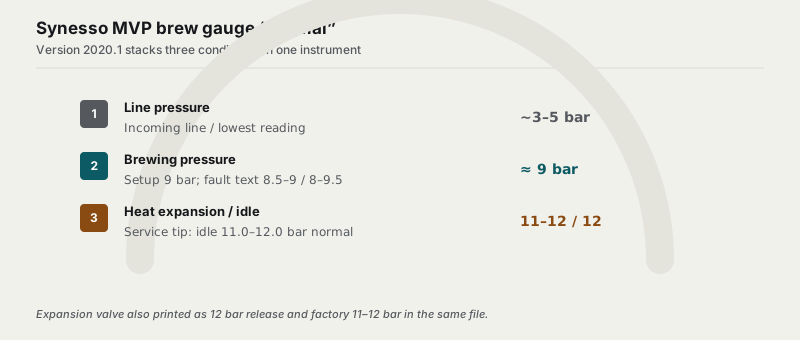
In the hydraulic-system description, the brew gauge is defined as reflecting pressure in the brewing system. The same paragraph then stacks three bands:
| Band in Version 2020.1 | Printed figure | Named condition |
|---|---|---|
| Line pressure | usually 3–5 bar | incoming line pressure (lowest reading) |
| Brewing pressure | 9 bar in the parts definition; 8.5–9 bar in fault text | while brewing |
| Expansion pressure | up to 12 bar; relief at 11 or 12 bar in fault text | brew tanks heating / expansion-valve release |
Startup instructions tell the installer to set pump pressure to 9 bar. The four-stage Hydra setup separately recommends full pressure 9 bar (with preinfusion 3.5 bar and bypass 7 bar as other stage setpoints). A later fault branch for a shot that pours too slowly says pump pressure may be too low and should be set between 8–9.5 bar.
So the manual’s own brew-pressure language is not a single acceptance number. 9 bar is the setup / recommended full-pressure figure. 8.5–9 bar is how troubleshooting describes what the needle “reflects” while brewing. 8–9.5 bar is a low-pressure fault band. Collapsing those into one “the brew gauge should read X” diagnosis is not what the file supports.
Idle heat is not the 3–5 bar band
The same troubleshooting page that assigns 3–5 bar to line pressure also says that when the brew tanks heat, the expansion valve relieves at 11 or 12 bar. Startup notes that as the brew groups heat, the brew-gauge needle may rise above 11 bar, and that each expansion valve is factory set to bleed at 11–12 bar. A fault titled “Brew Pressure is High (above 12 bar) While Machine is Idle” treats a reading above 12 bar at idle as the trigger to bring the maximum back to 11–12 bar.
Synesso’s technical-service page “Setting Your Expansion Valve” (canonical URL under /videos/…; datePublished 2021-06-02 and dateModified 2026-07-20 in the HTML) states the same relief band as 11.0 to 12.0 bar and adds an explicit tip:
TIP: It is normal to read 11.0 to 12.0 bar on the brew pressure gauge when the machine is at idle.
That tip is load-bearing for diagnosis. In these sources, 3–5 bar is the line-pressure / lowest reading class. 11–12 bar at idle is the heat-expansion class the manufacturer itself labels normal. A high idle reading in that band is not, by itself, evidence that the gauge is “wrong” relative to the 3–5 bar sentence.
The expansion valve’s printed ceiling is not one phrase
Inside Version 2020.1, the expansion valve is described two ways:
| Location | Expansion-valve language |
|---|---|
| Parts description | “The release point is 12 bar” |
| Startup note / factory setting | factory set to bleed at 11–12 bar; adjust near 11–12 so the brew gauge cannot exceed 12 bar |
| Quarterly / annual maintenance checks | “does not leak at 9 bar”; “11–12 bar is the factory standard setting” |
| Low-pressure cold-heat check | brew system reaches 10–12 bar while heating from a cold state |
The 12 bar release-point sentence and the 11–12 bar factory / idle-high language live in one file without a statement that one supersedes the other. The maintenance “does not leak at 9 bar” line is a third attachment: a brew-pressure leak check, not the heat-expansion ceiling. The cold-start 10–12 bar reachability check is a fourth. This article reports that split; it does not choose a correct spring setting and does not reproduce adjustment steps as instructions.
Open-group flow is a different diagnostic
The same maintenance pages also publish an open-group flow check — “Minimum 2 oz in 6–8 seconds” on the quarterly list, “2 oz water in 6–8 seconds” on the annual checklist — and a jet-clog fault line that says when operating properly, 60 ml should flow out within 8 seconds. Those figures are volume-over-time at the group, not brew-gauge pressure. They are cited here only to keep that measurand class separate from the three pressure bands above. This article does not treat the ounce and millilitre lines as a ranking of flow health across machines, and it does not convert them into a La Marzocco-style 30-second mass target.
Reading the bands without collapsing them
On the Synesso MVP & MVP Hydra Technical Manual Version 2020.1 (September 2020 / PDF metadata 2 October 2020), the brew-pressure gauge is assigned distinct normal bands for line pressure (~3–5 bar), brewing (9 bar, with 8.5–9 and 8–9.5 wording elsewhere), and heat expansion (11–12 / 12 bar). The manufacturer’s expansion-valve service note treats idle 11.0–12.0 bar as normal. The expansion valve’s release point is printed as 12 bar in the parts description and as factory 11–12 bar in startup and maintenance language, with a separate “does not leak at 9 bar” check and a cold-heat 10–12 bar reachability check.
That still leaves open whether every Synesso model shares these MVP/Hydra figures, whether 12 bar is wrong and 11–12 right (or the reverse), whether idle 11–12 bar equals brew pressure at the puck, whether the 2 oz / 60 ml open-group lines settle a restrictor-occlusion diagnosis for other brands, or whether the service page’s wrench directions should be followed as a how-to. Only Version 2020.1 and the expansion-valve service page are relied on here. Later owners’ manuals, unpublished service bulletins, and other Synesso model families were not checked. No measurement repeats a gauge reading or an open-group catch. For a La Marzocco Strada AV heat-up expansion ceiling split in the same diagnostic family, see that article.
Sources
References
Every source this article draws on, with a link or identifier a reader can follow to check it directly.
- Synesso, MVP & MVP Hydra Technical Manual, Version 2020.1, last update September 2020 (PDF metadata creation 2 October 2020) — https://ep-shopify.s3.amazonaws.com/related-documents/synesso/mvpseries/synesso-mvp-series-technical-manual.pdf. Cited for the brew-gauge 3–5 / 9 / 12 definition, startup pump set to 9 bar and expansion factory 11–12 / max 12 bar language, parts “release point is 12 bar,” maintenance leak-at-9 / factory 11–12 checks, open-group 2 oz / 6–8 s lines, and troubleshooting 8.5–9, 8–9.5, 10–12, and idle-above-12 wording.
- Synesso, “Technical Service: Setting Your Expansion Valve,” HTML with
datePublished2021-06-02 anddateModified2026-07-20 — https://synesso.com/videos/technical-service-setting-your-expansion-valve/. Cited for the 11.0–12.0 bar relief band and the tip that idle 11.0–12.0 bar on the brew gauge is normal — not for repair steps.