The SCAA prep page is not the heritage espresso definition
What this article adds
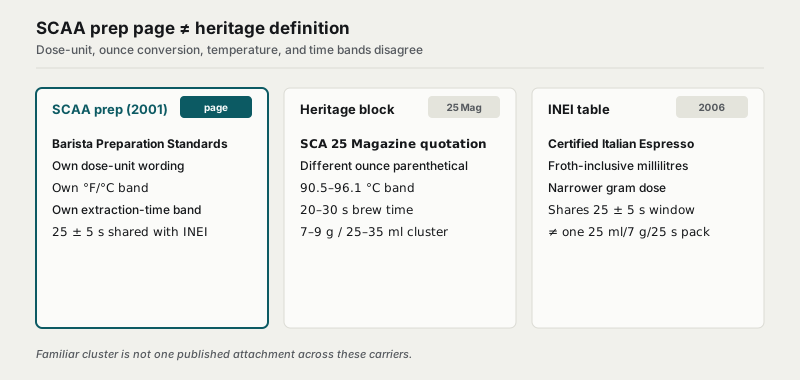
The March 2001 SCAA Barista Preparation Standards page and the “heritage” SCAA espresso definition quoted in SCA 25 Magazine Issue 3 disagree on dose-unit wording, beverage-volume ounce conversion, brew-water temperature band, and extraction-time band, while an INEI Certified Italian Espresso table that shares the page’s 25 ± 5 s window uses froth-inclusive millilitres and a narrower gram dose — so the familiar 25 ml / 7 g / 25 s cluster is not one published attachment.
Espresso’s most repeated preparation cluster — roughly 25 ml from about 7 g in about 25 seconds — usually travels as one inherited standard. The documents below do not attach those numbers that way. What follows compares three published roles in a fixed record: an archived SCAA certification / contest preparation page, the later “heritage” SCAA definition quoted by SCA’s own magazine when framing a brew-ratio survey, and an INEI Certified Italian Espresso parameter table. The attachments diverge, including inside SCAA/SCA’s own published wording.
Four attachments, not one recipe
| Attachment | Source | Volume / yield claim | Dose claim | Contact-time claim | Temperature claim |
|---|---|---|---|---|---|
| Contest / certification prep definition | SCAA “Preparation Standards,” Wayback 2001-03-03 | 25–35 ml beverage, parenthetical “1-1.25ounce” | “7-9 ounces” of fresh roast and ground coffee | About 25 s (± 5 s), grind and tamp managed | Brew water 88–92 °C (192–198 °F) |
| Labeled “heritage” SCAA definition | SCA 25 Magazine Issue 3 (Fasman / BGA survey write-up) | 25–35 ml, parenthetical “.85–1.2 ounce [×2 for double]” | 7–9 g (14–18 g for a double) | Brew time 20–30 s | Clean water 195–205 °F (90.5–96.1 °C) |
| Certified Italian Espresso technical table | INEI brochure, Dec 2006 | 25 ml ± 2.5 including froth | 7 g ± 0.5 | Percolation 25 s ± 5 s | Exit water from the unit 88 °C ± 2 °C |
| Practice-survey summary (not a definition) | Same 25 Magazine article | Average output 36.5 g by weight (82% weighed yield) | Average dose band reported 18–20 g | 51% reported average extraction 25–30 s | Average reported water temperature 200.3 °F |
Those rows are not interchangeable. The first two both travel under an SCAA label and both name a 25–35 ml beverage and 9–10 atmospheres, but they do not match on dose unit, ounce conversion, temperature band, or time band. The INEI table shares the page’s 25 ± 5 s window and a 7 g centre, but its millilitres are froth-inclusive and its temperature line is an exit-water certification figure, not the heritage quote’s forced-through water band. The survey averages are a fourth role: what 275 March 2017 respondents reported doing, not what either definition required.
What the 2001 SCAA page actually prints
The SCAA “Beverage Preparation Standards” page from the Internet Archive capture dated 3 March 2001 (20010303183606) states that SCAA Barista Certification and World Championship Contests use the same quality criteria. Its espresso paragraph reads, in the HTML:
A 25-35 ml (1-1.25ounce) beverage prepared with 7-9 ounces of fresh roast and ground coffee, where the 88-92ºC (192-198º F) brew water is pushed through the coffee at 9-10 atmospheres of pressure with the grind and tamp managed so that the extraction time is approximately 25 seconds (+/- 5 seconds)…
That is a certification / contest preparation definition on the page. It is not a mass brew-ratio recipe, and it does not say the millilitres include froth.
Two arithmetic checks belong to the page’s own parentheticals.
Using 1 US fluid ounce = 29.5735295625 ml, the page’s “1-1.25ounce” band is about 29.6–37.0 ml. That is not the same interval as the adjacent “25-35 ml.” The page prints both without reconciling them.
Reading “7-9 ounces” as avoirdupois mass (1 oz = 28.349523125 g) gives about 198–255 g of ground coffee — not a physically usable single-basket dose under ordinary espresso baskets. The page nonetheless prints “ounces.” This article does not amend the page to “grams,” invent an editorial intention, or claim that every unreachable SCAA document used the same wording. A Wayback capture listing for scaa.org/barista/standards.html returned only this 2001-03-03 capture among the status-200 rows checked here, so the negative is capture-scoped: this is the page text, not a survey of every SCAA revision.
What SCA later quotes as the “heritage” definition
David Fasman’s 25 Magazine Issue 3 piece “Defining the Ever-Changing Espresso,” written for the Specialty Coffee Association and framed around the Barista Guild of America espresso survey circulated in March 2017 (275 respondents), introduces a block quotation labeled the “heritage Specialty Coffee Association of America (SCAA) definition of espresso”:
Espresso is a 25–35ml (.85–1.2 ounce [×2 for double]) beverage prepared from 7–9 grams (14–18 grams for a double) of coffee through which clean water of 195°–205°F (90.5°–96.1°C) has been forced at 9–10 atmospheres of pressure, and where the grind of the coffee is such that the brew time is 20–30 seconds…
Against the 2001 page, four load-bearing attachments differ:
| Line | 2001 prep page | Heritage block in 25 Magazine |
|---|---|---|
| Dose unit / magnitude | “7-9 ounces” | 7–9 grams (14–18 g double) |
| ml↔oz parenthetical | 1–1.25 oz for 25–35 ml | 0.85–1.2 oz for 25–35 ml (and ×2 for double) |
| Brew-water temperature | 88–92 °C / 192–198 °F | 195–205 °F / 90.5–96.1 °C |
| Contact / brew time | ≈ 25 s (± 5 s) | 20–30 s |
The heritage ounce band is arithmetically near 25–35 ml: 0.85 oz ≈ 25.1 ml and 1.2 oz ≈ 35.5 ml. The page’s 1–1.25 oz band is not. Pressure (9–10 atmospheres) is the shared line.
The magazine does not cite the 2001 barista standards.html URL, does not present a facsimile of an older SCAA sheet, and does not explain the substitution of grams for ounces or the shifted temperature and time bands. What it does establish is SCA’s own published presentation of a “heritage” definition — and that presentation is not identical to the contest-standards page.
An earlier secondary circulation of the grams / 20–30 s / 195–205 °F form appears in The Atlantic on 2 June 2010, which attributes a closely worded 25–35 ml / 7–9 grams / 20–30 seconds recipe to the Specialty Coffee Association of America. That is trade journalism quoting SCAA, not an SCAA primary. It shows the grams-form cluster circulating years before the 2017 magazine piece; it does not authenticate the 2001 HTML, and it does not override it.
INEI’s froth-inclusive 25 ml at the same 25 ± 5 s window
The December 2006 Italian Espresso National Institute brochure The Certified Italian Espresso and Cappuccino (Centro Studi Assaggiatori; supplement to L’Assaggio n. 16) prints a technical-parameters table for Certified Italian Espresso. Among its lines:
- Necessary portion of ground coffee 7 g ± 0.5
- Percolation time 25 seconds ± 5 seconds
- Millilitres in the cup (including froth) 25 ml ± 2.5
The percolation window matches the SCAA page’s 25 ± 5 s extraction window. The volume line does not match either SCAA text’s bare 25–35 ml beverage wording: INEI’s millilitres are explicitly froth-inclusive, and the band is 22.5–27.5 ml centred on 25, not 25–35.
That matters for brew-ratio arithmetic. If someone treats INEI’s 7 g → 25 ml as a mass ratio with ml ≈ g, the ratio looks like about 1:3.6. The brochure’s own “including froth” clause blocks that reading: froth volume is not beverage mass. The SCAA texts do not supply a froth-inclusive qualifier to justify the same move in the other direction. None of the three definitional texts states a 1:2 mass brew ratio.
The brochure separately says the drink-in-a-cup conforms to INEI production specifications approved by a third-party body “operating in conformity with ISO standard 45011” (CSQA certificate n. 214, 24 September 1999). That is a claim about the certification body’s operating conformity, not a claim that ISO published the 7 g / 25 ml table as an ISO espresso recipe standard.
Exit temperature of water from the unit (88 °C ± 2 °C) is a different measurand from the SCAA pages’ brew-water / forced-through water bands and is not used here to adjudicate which temperature figure is “correct.”
What the same magazine reports as practice, not definition
After quoting the heritage definition, the 25 Magazine article reports the March 2017 survey. Among the published summaries: 82% of respondents measured espresso yield by weight; average weighed output was 36.5 g; the average reported brew ratio was 1:2 (example given: 20 g in and 40 g out; responses ranged 1:1.5–1:2.5); the majority reported lowest/highest doses consistent with an 18–20 g average-dose band; 51% reported average extraction time between 25 and 30 seconds.
Those figures are survey results about reported practice. They are not the heritage definition, not the 2001 contest page, and not the INEI certification table. Collapsing “average barista uses 1:2 by weight” into “the SCAA definition is 1:2” is exactly the role error this record is built to prevent.
Divergent attachments under one folk cluster
In these documents, the March 2001 SCAA Preparation Standards page and the heritage SCAA definition block quoted in SCA 25 Magazine Issue 3 disagree on dose-unit wording, the ml–oz parenthetical, brew-water temperature band, and extraction-time band, while sharing a 25–35 ml beverage framing and 9–10 atmospheres. The INEI December 2006 Certified Italian Espresso table shares that page’s 25 ± 5 s window and a 7 g centre but attaches froth-inclusive 25 ml ± 2.5 and a narrower gram dose. The magazine’s 1:2 / 36.5 g averages are practice-survey summaries, not those definitions. The 2001 page’s 1–1.25 oz parenthetical does not convert to 25–35 ml; the heritage 0.85–1.2 oz parenthetical nearly does.
That still leaves open whether “ounces” on the 2001 page was a typographical error SCAA meant to print as grams, whether the heritage block is wrong, whether INEI and SCAA are the same standard, whether 1:2 is undocumented as practice, whether no other SCAA document ever printed the grams-form text, or whether froth-inclusive volume can be converted to a unique mass brew ratio without density data. Those conclusions need documents this article does not have, or measurements it did not perform.
The familiar cluster survives as a folk compression of several published attachments. It does not survive as a single primary espresso definition. For the Matter 2020 SCA paraphrase versus heritage and Golden Cup attachments, and for where thirty pounds appears in the same bounded tamp record, see those reconciliations.
Sources
References
Every source this article draws on, with a link or identifier a reader can follow to check it directly.
- Specialty Coffee Association of America, “Preparation Standards.” Internet Archive capture 3 March 2001 (
20010303183606) ofhttp://scaa.org/barista/standards.html— https://web.archive.org/web/20010303183606id_/http://scaa.org:80/barista/standards.html. Historical evidence (archived certification / contest preparation standards page). - David Fasman, “Defining the Ever-Changing Espresso,” 25 Magazine Issue 3, Specialty Coffee Association — https://sca.coffee/sca-news/25-magazine/issue-3/defining-ever-changing-espresso-25-magazine-issue-3-zyx36. Association magazine article quoting a labeled “heritage” SCAA definition and reporting the March 2017 BGA espresso survey (275 respondents).
- The Atlantic, “Espresso 101: An Expert Responds to Readers,” 2 June 2010 — https://www.theatlantic.com/health/archive/2010/06/espresso-101-an-expert-responds-to-readers/57534/. Trade journalism (secondary quotation of an SCAA recipe form; not an SCAA primary).
- Odello, L., and Odello, C., The Certified Italian Espresso and Cappuccino, Italian Espresso National Institute / Centro Studi Assaggiatori, supplement to L’Assaggio n. 16, December 2006. Public mirror: https://olaszpresszo.hu/wp-content/uploads/2014/04/istituzionale_inei_hq_en.pdf. Certification / institute brochure (technical-parameters table and ISO 45011 conformity wording for the approving body).