SCA 310’s 50–175 test water is not the free brewing-water table
What this article adds
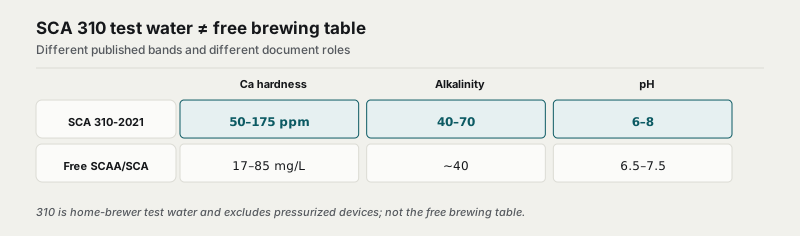
SCA Standard 310-2021’s home-brewer test-water summary (calcium hardness 50–175 ppm as CaCO₃; alkalinity 40–70; pH 6–8) is a different published band from the free SCAA/SCA Water for Brewing tables (calcium hardness 17–85 mg/L; alkalinity at or near 40; pH 6.5–7.5); 310 excludes pressurized devices; and Bratthäll et al. 2024 cite 310 for those figures while describing them as SCAA suggestions for favorable extraction.
“SCA water” is often spoken of as one band. In the free Specialty Coffee Association sources below, it is not. One published table gives calcium hardness 17–85 mg/L and alkalinity at or near 40 mg/L. Another SCA document, written for certifying atmospheric-pressure home filter brewers, summarises test water as calcium hardness 50–175 ppm as CaCO₃ and alkalinity 40–70 ppm as CaCO₃ — and expressly excludes home espresso machines and other pressurized devices. A 2024 open-access experimental paper then cites that second document while describing its numbers as what “the Specialty Coffee Association of America suggests… for favorable extraction.”
The question is which free SCA/SCAA text carries which band, what each document is for, and where a later paper collapses those roles — not which mineralisation recipe to brew with.
Three published roles
| Role | Source | Published water figures in that role |
|---|---|---|
| Free brewing-water target table | SCAA Water for Brewing Specialty Coffee (21 Nov 2009); repeated in SCA Coffee Standards (2018) §4.1 | Calcium hardness target 68 mg/L / range 17–85 mg/L; total alkalinity target 40 mg/L / “at or near 40 mg/L”; pH target 7.0 / 6.5–7.5; TDS target 150 mg/L / 75–250 mg/L |
| Home-brewer certification test water | SCA’s 2017 Certified Home Brewer program requirements, Testing Procedures §d | Baseline dissolved minerals 150 ppm ± 20 ppm, of which calcium hardness 17–85 mg/L; pH 7.0 ± 0.5 — no separate 40–70 alkalinity band on that page |
| Home-brewer standard test-water summary | SCA Standard 310-2021 §7.1.4 | “Complying with the current SCA Water standard,” summarised as odor-free, chlorine-free, calcium hardness equivalent to 50–175 ppm CaCO₃, alkalinity equivalent to 40–70 ppm CaCO₃, pH 6–8 |
Those rows are not interchangeable. The free table is a brewing-water characteristic list. The 2017 program page and 310 §7.1.4 are test-water conditions for evaluating home filter brewers. 310’s numeric summary is not the free table’s acceptable ranges, and it is not the 2017 program’s calcium-hardness band either.
What the free Water for Brewing tables publish
The 2009 SCAA one-page standard (WATER_STANDARD VERSION 21NOV2009A) states that the Statistics & Standards Committee “has determined” characteristics for water used to brew specialty coffee. For the hardness and alkalinity lines that matter here:
| Characteristic | Target | Acceptable Range |
|---|---|---|
| Calcium Hardness | 4 grains or 68 mg/L | 1–5 grains or 17–85 mg/L |
| Total Alkalinity | 40 mg/L | At or near 40 mg/L |
| pH | 7.0 | 6.5 to 7.5 |
SCA Coffee Standards (Revised 2018) §4.1 reprints the same table under the same committee attribution. Neither free document states calcium hardness 50–175 ppm as CaCO₃, nor alkalinity 40–70 ppm as CaCO₃, nor pH 6–8 as the acceptable band.
What those free tables are for is stated in their own purpose language: standards for water used to brew specialty coffee, with targets as optima inside acceptable ranges. They are not written as the test protocol for home-brewer certification. A separate article on the free SCAA brewing-water tables examines whether those free tables show a derivation of 150/68/40; this article does not repeat that provenance check. It only needs the published bands.
What SCA Standard 310-2021 publishes
SCA Standard 310-2021, Home Coffee Brewers: Specifications and Test Methods (© 2022 Specialty Coffee Association; developed under SCA’s standards program), is an equipment standard. Its scope covers “filter coffee electrical brewers designed for home use at atmospheric pressure” and excludes “home espresso machines, pressurized brewing devices,” among other device classes. That exclusion is the espresso-relevant boundary: 310 is not a pressurized-extraction water standard.
In test methods §7.1.4, the water requirement is:
Fresh, cold water at 17±3°C, complying with the current SCA Water standard, shall be used in all the brew testing: this is summarized as odor-free, free of chlorine, calcium hardness equivalent to 50 to 175 ppm CaCO₃, alkalinity equivalent to 40 to 70 ppm CaCO₃, and pH of 6 to 8.
Two separations follow from that sentence alone.
Document role. The figures appear as a summary of test water for home-brewer compliance testing, not as a reprint of the free Cover + 1 brewing-water table.
Numeric mismatch with the free table. 50–175 (calcium hardness as CaCO₃) is not 17–85. Alkalinity 40–70 is not “at or near 40.” pH 6–8 is not 6.5–7.5. 310 asserts that this summary is “the current SCA Water standard.” The free Water for Brewing tables do not match that summary. The paid SCA Water Quality Handbook is outside the free sources used here, so this check does not adjudicate whether that handbook carries 50–175 / 40–70. It establishes that two free published SCA/SCAA water texts disagree, and that 310’s wording claims continuity the free table does not display.
The 2017 certification program used the narrower hardness band
310’s preface says the standard is derived from SCA’s Minimum Certification Requirements for Coffee Brewers and the Certified Home Brewer program’s uniformity procedure. The 2017 program-requirements PDF, under Testing Procedures §d “Water,” still uses the free table’s hardness width for brew testing:
Fresh, cold water 15±5 degrees Celsius (°C), containing a baseline dissolved mineral content of 150 ppm (0.150%) with a tolerance of 20 ppm (+/- 0.20%), of which a sub-set of hard minerals is 17 mg/L - 85 mg/L calcium hardness, and a pH of 7.0 (+/- 0.5) will be used in all of the brew testing.
That page does not state alkalinity 40–70. Inside the free certification family, therefore, test water moved from a 17–85 calcium-hardness window (2017 program) to a 50–175 summary (310-2021), while 310 continues to describe its summary as the current SCA Water standard. The revision is visible without opening the paid handbook.
How Bratthäll et al. 2024 attach the 310 band
Bratthäll, Figueira, and Nording, Heliyon 10, e26625 (2024), DOI 10.1016/j.heliyon.2024.e26625, write in the introduction:
The Specialty Coffee Association of America suggests a total hardness between 50 and 175 ppm CaCO₃, an alkalinity between 40 and 70 ppm CaCO₃ and a pH near 7 for favorable extraction [2].
Their reference [2] is Specialty Coffee Association, Home coffee brewers: specifications and test methods, SCA Standard 310-2021 — the equipment standard examined above — not the free Water for Brewing Cover + 1 table.
Set against the 310 text, three attachments slip:
- Document identity. The cited source is a home filter-brewer test-methods standard that excludes pressurized devices. It is not labelled in 310 as a general SCAA “favorable extraction” recommendation for brewing water.
- Hardness wording. 310 summarises calcium hardness equivalent to 50–175 ppm as CaCO₃. Bratthäll et al. write total hardness for the same numeric band.
- pH wording. 310 states pH 6 to 8. The paper’s prose says “near 7.”
Bratthäll et al. appear here only as a dated, checkable specimen of that conflation — not as a water-standard authority, and not for their organic-acid GC-MS/NMR results.
Where “SCA water” actually sits in these free texts
Across the free sources used here, “SCA water” is at least two published bands. The free SCAA/SCA Water for Brewing tables give calcium hardness 17–85 mg/L and alkalinity at or near 40 mg/L. SCA Standard 310-2021 summarises home-brewer test water as calcium hardness 50–175 ppm as CaCO₃ and alkalinity 40–70 ppm as CaCO₃, while excluding home espresso and other pressurized devices. The 2017 Certified Home Brewer requirements still used 17–85 mg/L calcium hardness for testing. Bratthäll et al. 2024 cite 310 for the wider band and describe those figures as SCAA suggestions for favorable extraction.
That comparison does not say which band an unread Water Quality Handbook prints, or which figure a machine manufacturer should adopt. It does not say that 50–175 / 40–70 is “wrong,” only that it is not the free brewing-water table’s published acceptable ranges. It does not settle espresso extraction optima, magnesium preference, or a home mineralisation recipe. And it does not claim that every secondary source that quotes 50–175 made the same citation error — only that this Heliyon paper pairs that band with a 310 citation under favorable-extraction wording.
Sources
References
Every source this article draws on, with a link or identifier a reader can follow to check it directly.
- Specialty Coffee Association of America, SCAA Standard | Water for Brewing Specialty Coffee, WATER_STANDARD VERSION 21NOV2009A, revised 21 November 2009. Public mirror: https://www.urbansaqua.com/wp-content/uploads/2023/09/www.urbansaqua.com-robust-ro-drinking-water-systems-water-standards.pdf
- Specialty Coffee Association, Coffee Standards, revised 2018, §4.1. Public mirror: https://editordecafe.com/wp-content/uploads/2019/03/6ec09-coffeestandards-digital.pdf
- Specialty Coffee Association, SCA Standard 310-2021 Home Coffee Brewers: Specifications and Test Methods (© 2022). Public host used for this check: https://coffeegeek.com/wp-content/uploads/2023/10/SCAGoldCupStandard.pdf. Cited for scope exclusions (including home espresso / pressurized devices) and §7.1.4 test-water summary (calcium hardness 50–175 ppm as CaCO₃; alkalinity 40–70 ppm as CaCO₃; pH 6–8).
- Specialty Coffee Association, SCA’s Minimum Certification Requirements for Coffee Brewers / Certified Home Brewer Program requirements (2017). Public host used for this check: https://links.imagerelay.com/cdn/2615/ql/4bf57b3a901046b492d45b7015455c76/2017-SCA-CHB-Program-Requirements.pdf. Cited for Testing Procedures §d water: 150 ppm ± 20 ppm dissolved minerals with calcium hardness 17–85 mg/L and pH 7.0 ± 0.5.
- Bratthäll, T., Figueira, J., and Nording, M.L., “Influence of divalent cations on the extraction of organic acids in coffee determined by GC-MS and NMR,” Heliyon 10(5), e26625 (2024). DOI 10.1016/j.heliyon.2024.e26625. PMC PMC10907646. Cited for the introduction’s attribution of 50–175 / 40–70 / near-7 to SCAA “for favorable extraction” and for reference [2] identifying SCA Standard 310-2021.
- Specialty Coffee Association, standards index — https://sca.coffee/research/coffee-standards