Weber’s “5 micron stepped adjustment” is not one attachment
What this article adds
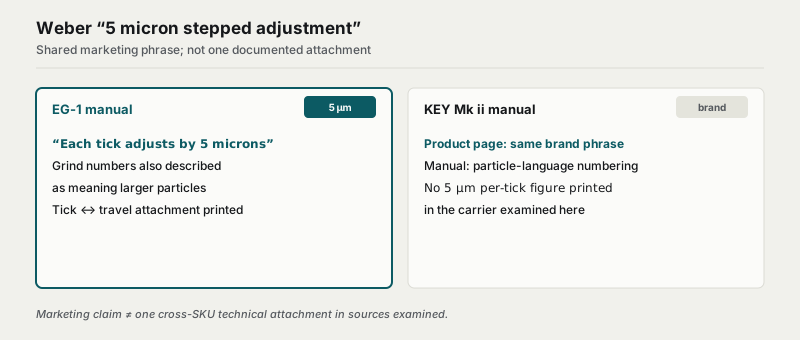
Weber Workshops’ EG-1 and KEY product pages both brand a “5 micron stepped adjustment,” while the EG-1 instruction manual attaches “each tick adjusts by 5 microns” to grind numbers it also describes as meaning larger particles, and the KEY Mk ii manual restates particle-language grind numbering without printing a 5 µm per-tick figure — so the 5 µm marketing claim is not one documented attachment across those carriers.
A micron figure next to a coffee grinder is incomplete until the role is named: particle-size summary, burr-gap / axial travel, dial travel per detent, or something else. Weber Workshops’ own product pages force that naming for a different reason. Both the EG-1 and the KEY are marketed with a 5 micron stepped adjustment. Only one of the two instruction manuals below prints a matching 5 µm per-tick sentence, and that sentence still does not say whether the five microns are burr travel or particle diameter.
This is not a dial-in guide and not a ranking of Weber grinders. It reconciles what the manufacturer carriers below attach the five-micron figure to.
Product pages: the same five-micron brand on two models
On the EG-1 product page, under “Thoughtful Details,” a feature is headed 5 Micron Stepped Adjustment. The accompanying copy says the user can “Effortlessly and precisely adjust from Turkish-fine to filter-appropriate and back again,” and that this “allows for easy switching between types and styles of coffee without the effort and and waste of cleaning a grinder and purging/redialing.” That block brands a five-micron stepped adjustment. It does not, in the text, say that each detent moves the burrs by 5 µm, that particle size changes by 5 µm, or that a named PSD statistic is being displayed.
On the KEY product page, the same numeric brand appears as 5 micron stepped adjustment in the feature list and as image alt / gallery title text. The matching detail-gallery body says: “Simple stepped adjustment easily takes you from Turkish-fine to v60 ready.” Again the page markets a five-micron step. Again the block does not name burr distance, axial travel, or a particle-size mean.
So across two product pages, Weber attaches the same five-micron marketing label to stepped grind adjustment without publishing, beside that label, a single measurand definition.
EG-1 manual: five microns per tick beside particle language
The EG-1 instruction manual (Shopify CDN filename and PDF metadata title EG-1 Instruction Manual (2026 edit) - V3; page footers still print Copyright 2022 and manual version 2.0) states, under quickstart step 10 - Adjust the Grind:
Larger numbers mean larger particles, and each tick adjusts by 5 microns.
The same paragraph says adjustments coarser and finer are done by lifting the locking ring and turning, and that “There is no absolute zero.”
Two attachments sit in that one sentence:
- Dial numbers and particles. “Larger numbers mean larger particles” — qualitative particle-size language for the numbered setting.
- Tick size. “each tick adjusts by 5 microns” — a five-micron figure attached to each tick, without naming the physical quantity those microns measure.
The manual does not say “each tick moves the burr by 5 microns,” and it does not say “particle size changes by 5 microns,” and it does not name d[3,2], d[4,3], X50, or another PSD statistic. Read against this site’s 1Zpresso and Mazzer reconciliations, that omission matters: those manufacturers’ carriers explicitly attach micrometres to burr travel or burr distance. Weber’s EG-1 manual puts particle language and a 5 µm tick figure in one sentence without completing either attachment.
KEY Mk ii manual: particle language without the five-micron figure
The KEY instruction manual (KEY_Instruction_Manual_2023_edit_-_v5.2.pdf; footers Copyright 2023 Weber Workshops, manual version Mk ii) has a parallel quickstart step 9 - Adjust the Grind. It says adjustments are made by lifting the locking ring and turning, and:
Larger numbers mean larger particles (clockwise = coarser).
That is the same particle-language attachment as the EG-1 manual’s “larger numbers mean larger particles.” On the KEY Mk ii PDF, a full-text extract contains no “micron,” “5 micron,” or µm string. The product page’s five-micron stepped-adjustment brand is therefore not reprinted as a per-tick figure in the KEY manual that carries the matching grind-adjustment instructions.
What this rules out, within these documents
Within the EG-1 product page, KEY product page, EG-1 manual, and KEY Mk ii manual:
- “5 micron stepped adjustment” is a shared product-page brand on EG-1 and KEY; it is not, by itself, a published particle-size band or a published burr-gap specification.
- The EG-1 manual’s “each tick adjusts by 5 microns” is the carrier that attaches 5 µm to a tick; it still does not name whether those microns are axial burr travel or particle diameter.
- The KEY Mk ii manual restates particle-language grind numbering without printing the 5 µm per-tick figure the KEY product page markets.
- None of these four carriers, in the text, converts the five-micron step into a named PSD statistic.
Those are scoped negatives about the Weber carriers. They are not a claim that no Weber gap calibration or particle-size measurement exists elsewhere, and they are not a recipe for either grinder. A “5 micron” quote from a Weber product page remains a stepped-adjustment marketing label until a document says what was measured — and when only one of two model manuals prints the matching per-tick figure, the product-page brand alone does not pick which attachment is being quoted.
Limits
- EG-1 manual identity is the “2026 edit” / V3 PDF whose footers still read Copyright 2022 and manual version 2.0; later silent revisions are outside the scope of this article.
- KEY product HTML and EG-1 product HTML may change without a changelog; load-bearing sentences were verified in the mirrored retrievals.
- Filter / pour-over wording on the product pages is used only to show that the five-micron brand is attached to brew-range switching language, not as brew-method instruction.
- Distinct from this site’s 1Zpresso and Mazzer articles: those concern manufacturer carriers that explicitly define micrometres as burr travel or burr distance. The Weber finding here is that the five-micron step is marketed on two models, printed as a per-tick figure on only one manual, and left without an explicit measurand on that manual.
Sources
References
Every source this article draws on, with a link or identifier a reader can follow to check it directly.
- Weber Workshops, The EG-1 product page, https://weberworkshops.com/products/eg-1
- Weber Workshops, The KEY product page, https://weberworkshops.com/products/key-grinder
- Weber Workshops, EG-1 Coffee Grinder Instruction Manual (CDN filename / PDF title: EG-1 Instruction Manual (2026 edit) - V3; footer: Copyright 2022, manual version 2.0), https://cdn.shopify.com/s/files/1/0268/7614/9813/files/EG-1_Instruction_Manual_2026_edit_-_V3.pdf
- Weber Workshops, KEY Coffee Grinder Instruction Manual (CDN filename
…2023_edit_-_v5.2.pdf; footer: Copyright 2023, manual version Mk ii), https://cdn.shopify.com/s/files/1/0268/7614/9813/files/KEY_Instruction_Manual_2023_edit_-_v5.2.pdf