WBC’s machine pressure band is not heritage nine-to-ten
What this article adds
The 2024–2026 World Barista Championship Official Rules attach an 8.5–9.5 bar espresso-machine brewing / pump-pressure band as a fixed, competitor-inalterable equipment setting, while the labeled heritage SCAA definition in SCA 25 Magazine Issue 3 and a March 2001 SCAA preparation page attach 9–10 atmospheres, Cameron et al. (Matter 2020) attribute 9–10 bar of static water pressure to a historical SCA definition, and INEI’s December 2006 Certified Italian Espresso table attaches entry water pressure 9 bar ± 1 — so the familiar “nine bar” cluster is not one published attachment.
“Nine bar,” competition rules, and “the SCA definition” are often spoken of as one pressure attachment. In the sources below they are not. Competition equipment wording, SCA-family definitional wording, a peer-reviewed SCA paraphrase, and an INEI certification table sit side by side here, with one practice-survey summary kept as a separate role. The World Barista Championship’s 8.5–9.5 bar machine band is not the heritage / Matter 9–10 atmosphere-or-bar band, and INEI’s 9 bar ± 1 window is a third published shape.
It does not prescribe a brew pressure, rank café practice against competition, convert atmospheres into bars as a physical calibration, or reopen the site’s separate articles on pump-versus-gauge-versus-puck pressure, fifteen-bar pump nameplates, WBC dose and volume wording, or Matter’s temperature and extraction-yield paraphrases beyond pointers.
Pressure attachments, not one “nine bar”
| Role | Source | Pressure wording | What the band is attached to |
|---|---|---|---|
| Competition equipment setting | WBC Official Rules 2024, 2025, and 2026, §3.1.G (and later pump-configuration prose) | 8.5 and 9.5 bars | Espresso-machine “brewing pressure” / “pump pressure” on the sponsored machine; competitors cannot alter it |
| Labeled “heritage” SCAA definition | SCA 25 Magazine Issue 3 (Fasman / BGA survey write-up) | 9–10 atmospheres | Water “forced” through the coffee in the definitional sentence |
| Contest / certification prep definition | SCAA “Preparation Standards,” Wayback 2001-03-03 | 9–10 atmospheres | Brew water “pushed through the coffee” on that archived page |
| Peer-reviewed paraphrase labeled historical SCA definition | Cameron et al., Matter 2, 631–648 (2020), Introduction | 9–10 bar of static water pressure | “Historically defined by” SCA espresso sentence |
| Certified Italian Espresso technical table | INEI brochure, Dec 2006 | 9 bar ± 1 | “Entry water pressure” in the certification-parameter table |
| Practice-survey summary (not a definition) | Same 25 Magazine article | Average 8.5 bars; most responses at 9 bars | March 2017 BGA survey of what respondents reported using |
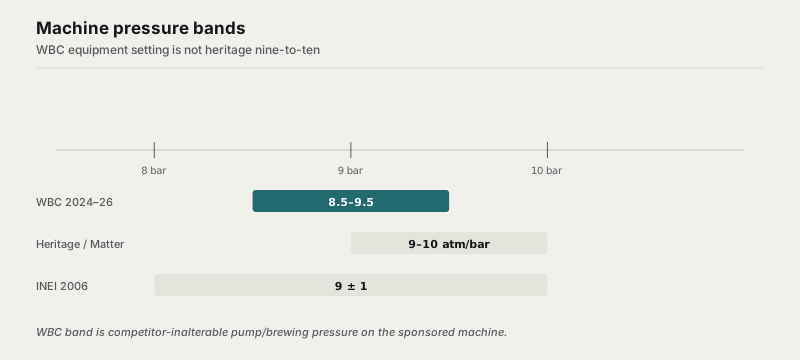
Those rows are not interchangeable. Three of them travel under an SCA / SCAA label and all three name a 9–10 unit band, but WBC — the competition rulebook many readers treat as the living specialty standard — publishes a different numeric interval and labels it as machine brewing / pump configuration rather than as a forced-through definitional pressure in the heritage sense. INEI’s centre is 9 bar, but its published tolerance opens at 8 and closes at 10.
What three WBC rulebooks attach
The 2024, 2025, and 2026 World Barista Championship Official Rules and Regulations, from the World Coffee Championships rules host, each state under beverage definitions §3.1.G:
The espresso machine brewing pressure will be set between 8.5 and 9.5 bars.
Later equipment prose in the same rulebooks restates the interval as pump configuration: the WBC-provided espresso machine has a fixed technical configuration for the pump pressure (between 8.5 and 9.5 bars) and cannot be altered by the competitors. Across the three years, that pair of labels — “brewing pressure” in §3.1.G and “pump pressure” in the equipment passage — is stable. The numeric band does not soften the way the 2025–2026 beverage-volume line softens.
That matters for role. The rules are attaching a sponsored-machine setpoint band, not a measured puck-inlet pressure, not a gauge-tap reading on an arbitrary plumbing layout, and not a café house recipe. A separate article already separates pump output, gauge reading, and puck inlet as different quantities; this piece does not re-derive that mechanism. It records only that competition’s published attachment for “brewing pressure” / “pump pressure” is 8.5–9.5 bar in the 2024–2026 rulebooks.
Against a heritage floor of 9, the WBC band’s lower edge is below that floor. Against a heritage ceiling of 10, the WBC band’s upper edge is below that ceiling. Treating “WBC espresso is nine bar” as identical to “heritage espresso is 9–10 atmospheres” erases both edges.
A companion article on this site already matrices WBC dose, volume, and contact-time wording for the same three rulebooks and scopes machine pressure as an equipment setting not used there. The present article is the pressure-band half of that record.
What the SCA-family texts attach
David Fasman’s 25 Magazine Issue 3 piece “Defining the Ever-Changing Espresso,” on the Specialty Coffee Association site, introduces a block quotation labeled the “heritage Specialty Coffee Association of America (SCAA) definition of espresso”:
Espresso is a 25–35ml (.85–1.2 ounce [×2 for double]) beverage prepared from 7–9 grams (14–18 grams for a double) of coffee through which clean water of 195°–205°F (90.5°–96.1°C) has been forced at 9–10 atmospheres of pressure, and where the grind of the coffee is such that the brew time is 20–30 seconds…
The pressure line in that block is 9–10 atmospheres. It is not printed as 8.5–9.5 bar, and it is not labeled a pump setpoint on a sponsored machine.
The March 2001 SCAA page “Beverage Preparation Standards” page — already reconciled elsewhere on this site against that heritage block for dose-unit, ounce, temperature, and time wording — agrees with the heritage block on pressure: brew water is “pushed through the coffee at 9-10 atmospheres of pressure.” The pressure attachment is the shared SCA-family line in those two texts; it is not the WBC equipment band.
Cameron, Hendon, Foster and co-authors, “Systematically Improving Espresso: Insights from Mathematical Modeling and Experiment,” Matter 2, 631–648 (4 March 2020), DOI 10.1016/j.matt.2019.12.019, from the University of Oregon author PDF, introduce espresso with this uncited historical-definition sentence:
As historically defined by the Specialty Coffee Association, an espresso is a 25–35 mL (ca. 20–30 g) beverage prepared from 7–9 g of ground coffee made with water heated to 92°C–95°C, forced through the granular bed under 9–10 bar of static water pressure and a total flow time of 20–30 s.
Relative to the heritage block, the paper’s pressure parenthetical is “9–10 bar of static water pressure,” not “9–10 atmospheres,” and not “8.5–9.5 bars.” A separate article already shows that the same Matter sentence’s beverage-mass parenthetical and 92–95 °C band do not match the heritage quotation; the present comparison keeps only the pressure labels.
This article does not convert atmospheres to bar, and it does not claim that “atmosphere” and “bar” are identical units on the page. Even if a reader treats them as approximately interchangeable for conversational “nine to ten,” the WBC interval remains a different published band: it opens at 8.5 and closes at 9.5.
INEI’s 9 ± 1 is a third shape
The December 2006 Italian Espresso National Institute brochure The Certified Italian Espresso and Cappuccino (Centro Studi Assaggiatori; supplement to L’Assaggio n. 16) prints a technical-parameters table for Certified Italian Espresso. Among its lines:
- Entry water pressure 9 bar ± 1
That is a centred 9 with a one-bar tolerance — numerically 8 to 10 bar if the ± is read as an inclusive window. It overlaps the WBC equipment band and the heritage 9–10 band, but it is not identical to either: it admits 8.0, which neither heritage 9–10 nor WBC’s closed 8.5–9.5 wording states as a matching interval, and it admits 10.0, which WBC’s upper edge does not. The brochure’s label is “entry water pressure,” another role from WBC’s “brewing pressure” / “pump pressure” equipment prose and from the heritage “forced at … atmospheres” definitional wording.
No Caprioli citation claim is made here; the table is read from the INEI brochure alone.
Survey averages are a fourth role
The same 25 Magazine Issue 3 article reports the March 2017 Barista Guild of America espresso survey (275 respondents). On pressure it states that the average pressure used to extract espresso was 8.5 bars, with the most responses at 9 bars. That is practice-summary language, not a rulebook setpoint and not a heritage definition. The average coincidentally matches WBC’s lower edge; the modal response matches the conversational “nine.” Neither fact collapses the four definitional / certification attachments above into one published band.
Different published “nine bar” attachments
In the 2024–2026 WBC Official Rules, competition espresso attaches machine brewing pressure / pump pressure as 8.5–9.5 bar on a fixed sponsored-machine configuration. The labeled heritage SCAA block in SCA 25 Magazine Issue 3 and the March 2001 SCAA preparation page attach 9–10 atmospheres. Matter (2020) attributes 9–10 bar of static water pressure to a historical SCA definition. INEI’s December 2006 table attaches entry water pressure 9 bar ± 1. Those are different published attachments under the broad “nine bar” conversation. The magazine’s 8.5-bar average / 9-bar mode is survey practice only.
None of that settles whether 8.5–9.5 bar is what reaches the puck on the sponsored machine, whether atmospheres and bar are interchangeable without a conversion convention, whether INEI’s ±1 is a measurement uncertainty rather than a certification window, whether heritage 9–10 is wrong, which row cafés should set, or whether every historical WBC edition before 2024 used the same band. Those conclusions need instruments or documents this article does not claim.
Sources
References
Every source this article draws on, with a link or identifier a reader can follow to check it directly.
- World Coffee Events / World Coffee Championships, 2024 World Barista Championship Official Rules and Regulations — https://wcc.coffee/s/2024-World-Barista-Championship-Official-Rules-and-Regulations-lfer.pdf (listed on https://wcc.coffee/rules-regulations). Competition rules (beverage definition §3.1.G brewing-pressure band; pump-pressure equipment prose).
- World Coffee Championships, 2025 World Barista Championship Official Rules and Regulations — https://wcc.coffee/s/2025-World-Barista-Championship-Official-Rules-and-Regulations.pdf. Competition rules (same 8.5–9.5 bar brewing / pump-pressure attachments).
- World Coffee Championships, 2026 World Barista Championship Official Rules and Regulations — https://wcc.coffee/s/2026-World-Barista-Championship-Official-Rules-and-Regulations.pdf. Competition rules (same 8.5–9.5 bar brewing / pump-pressure attachments).
- David Fasman, “Defining the Ever-Changing Espresso,” 25 Magazine Issue 3, Specialty Coffee Association — https://sca.coffee/sca-news/25-magazine/issue-3/defining-ever-changing-espresso-25-magazine-issue-3-zyx36. Association magazine article (labeled “heritage” SCAA definition quotation; March 2017 BGA espresso survey pressure summaries).
- Specialty Coffee Association of America, “Beverage Preparation Standards” / barista preparation standards page, Internet Archive capture 2001-03-03 (
20010303183606) — https://web.archive.org/web/20010303183606/http://www.scaa.org/barista/standards.html. Archived association page (9–10 atmospheres wording on the capture). - Michael I. Cameron et al., “Systematically Improving Espresso: Insights from Mathematical Modeling and Experiment,” Matter 2, 631–648 (2020), DOI 10.1016/j.matt.2019.12.019. Author PDF: https://pages.uoregon.edu/chendon/publications/2020/74.%20Matter,%20Espresso%20extraction.pdf. Peer-reviewed article (SCA-attributed historical definition with 9–10 bar static water pressure).
- Odello, L., and Odello, C., The Certified Italian Espresso and Cappuccino, Italian Espresso National Institute / Centro Studi Assaggiatori, supplement to L’Assaggio n. 16, December 2006. Public mirror: https://olaszpresszo.hu/wp-content/uploads/2014/04/istituzionale_inei_hq_en.pdf. Certification / institute brochure (entry water pressure 9 bar ± 1).