Matter 2020’s SCA paraphrase is not the heritage definition or Golden Cup
What this article adds
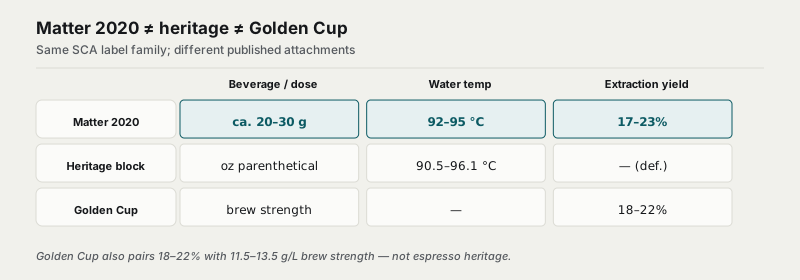
Cameron et al. (Matter 2020) attribute to the Specialty Coffee Association a historical espresso definition with a ca. 20–30 g beverage-mass parenthetical and a 92–95 °C water band that do not match the SCA 25 Magazine heritage SCAA block’s ounce parenthetical and 90.5–96.1 °C band, and the same paper’s attributed 17–23% extraction-yield advice band is not the free SCA Golden Cup Standard’s 18–22% solubles-extraction attachment (paired there with 11.5–13.5 g/L brew strength).
“The SCA definition” and “the SCA extraction band” circulate as if each named one attachment. The sources below show they do not. What follows places three published roles side by side: what Cameron, Hendon, Foster and co-authors print as a historical Specialty Coffee Association espresso definition and as SCA extraction-yield advice in Matter (2020); the labeled “heritage” SCAA espresso definition quoted in SCA 25 Magazine Issue 3; and the free SCA Coffee Standards (Revised 2018) Golden Cup Standard sentence. The paper’s SCA-attributed yield-mass, temperature, and percent-extraction figures are not the attachments those free SCA texts carry.
It does not prescribe a recipe, rank cafe practice against competition rules, or reopen the separate 2001 SCAA preparation page versus heritage ounce/gram reconciliation beyond a pointer.
Three attachments, not one SCA package
| Role | Source | Beverage / yield claim | Dose claim | Temperature claim | Extraction / time claim |
|---|---|---|---|---|---|
| Peer-reviewed paraphrase labeled historical SCA definition | Cameron et al., Matter 2, 631–648 (2020), Introduction | 25–35 mL (ca. 20–30 g) | 7–9 g ground coffee | Water heated to 92–95 °C | Total flow time 20–30 s; pressure 9–10 bar |
| Labeled “heritage” SCAA definition | SCA 25 Magazine Issue 3 (Fasman / BGA survey write-up) | 25–35 ml (.85–1.2 ounce [×2 for double]) | 7–9 g (14–18 g double) | Clean water 195–205 °F (90.5–96.1 °C) | Brew time 20–30 s; pressure 9–10 atmospheres |
| Free Golden Cup Standard (not an espresso definition) | SCA Coffee Standards, Revised 2018, §5.1 | Brew strength 11.5–13.5 g/L TDS (1.15–1.35% on the SCA Brewing Control Chart) | Not stated as an espresso dose | Not stated in §5.1 | Solubles extraction yield 18 to 22 percent* — not 17–23% |
Those rows are not interchangeable. The first two both travel under an SCA / SCAA label and both name a 25–35 ml beverage, a 7–9 g dose, 9–10 bar/atm pressure, and a 20–30 s window, but they disagree on how beverage yield is parenthesised and on the water-temperature band. The third is a different role entirely: a brew-strength plus percent-extraction Golden Cup sentence with no espresso dose, no espresso volume, and no contact-time line.
What Matter 2020 attributes to SCA
Cameron et al., “Systematically Improving Espresso: Insights from Mathematical Modeling and Experiment,” Matter 2, 631–648 (4 March 2020; online 22 January 2020), DOI 10.1016/j.matt.2019.12.019, from the University of Oregon author PDF, introduce espresso quality variation with this uncited historical-definition sentence:
As historically defined by the Specialty Coffee Association, an espresso is a 25–35 mL (ca. 20–30 g) beverage prepared from 7–9 g of ground coffee made with water heated to 92°C–95°C, forced through the granular bed under 9–10 bar of static water pressure and a total flow time of 20–30 s.
Two load-bearing attachments in that sentence are the paper’s own parentheticals relative to the heritage block below: beverage mass “ca. 20–30 g” beside 25–35 mL, and water temperature stated only as 92–95 °C.
A few paragraphs later, still in the Introduction and still without an adjacent citation marker on the advice sentence, the paper attributes an extraction-yield band to SCA:
Accordingly, the Specialty Coffee Association advises that coffee most frequently tastes best when the proportion of extracted dry mass is in the range 17%–23%. Coffee beverages with EYs exceeding 23% typically taste bitter, while those below 17% are often sour.
Later, under “Systematic Reduction of Coffee Mass…,” the paper states that “The Specialty Coffee Association espresso parameters mandate that the extraction should take 20–30 s.” That is the paper’s verb (“mandate”) for a 20–30 s window. The Introduction’s model framing also says that, “In a departure from the Specialty Coffee Association recommendations, the model suggests that we should ignore brew time and navigate the EY landscape using only mass of coffee and mass of water as independent variables.”
The Experimental Procedures section separately records the authors’ own modern recipe used for measurement: 20.0(5) g dry coffee in, 40.0(5) g beverage out, temperature held at 92 °C. That is the paper’s experimental attachment, not the historical-definition sentence.
What the heritage SCAA block actually prints
David Fasman’s 25 Magazine Issue 3 piece “Defining the Ever-Changing Espresso,” on the Specialty Coffee Association site, introduces a block quotation labeled the “heritage Specialty Coffee Association of America (SCAA) definition of espresso”:
Espresso is a 25–35ml (.85–1.2 ounce [×2 for double]) beverage prepared from 7–9 grams (14–18 grams for a double) of coffee through which clean water of 195°–205°F (90.5°–96.1°C) has been forced at 9–10 atmospheres of pressure, and where the grind of the coffee is such that the brew time is 20–30 seconds…
Against the Matter paraphrase, four attachments matter for dose, yield, temperature, and time:
| Line | Matter 2020 “historically defined by” SCA | Heritage block in 25 Magazine |
|---|---|---|
| Beverage parenthetical | ca. 20–30 g beside 25–35 mL | .85–1.2 ounce (×2 for double) beside 25–35 ml |
| Water temperature | 92–95 °C only | 195–205 °F (90.5–96.1 °C) |
| Dose | 7–9 g | 7–9 g (14–18 g double) |
| Contact / brew time | 20–30 s total flow time | 20–30 s brew time |
The shared 25–35 ml framing and 7–9 g dose do not make the parentheticals or temperature bands the same attachment. Treating “ca. 20–30 g” as a density conversion of 25–35 ml would still not recover the heritage ounce band: 0.85–1.2 US fl oz is about 25.1–35.5 ml, while 20–30 g as mass is a different interval from both 25–35 ml and that ounce parenthetical if ml ≈ g. The paper does not derive the 20–30 g figure from the ounce parenthetical, and the heritage block does not print a gram beverage-yield parenthetical.
The Fahrenheit↔Celsius pair in the heritage block is internally consistent (195 °F = 90.56 °C; 205 °F = 96.11 °C). The Matter sentence’s 92–95 °C band is not that pair.
The magazine article does not cite Cameron et al.; Cameron et al. do not cite the 25 Magazine heritage quotation. This article does not claim that one text intended to paraphrase the other. It records that both are published under SCA/SCAA labeling and that the attachments disagree.
A separate published reconciliation on this site already shows that a March 2001 SCAA barista Preparation Standards page is itself not identical to this heritage block (dose-unit wording, ounce conversion, temperature band, and time band). That 2001 page is not re-; the present comparison is Matter versus the heritage quotation and versus Golden Cup.
What free Golden Cup attaches — and what it does not
SCA Coffee Standards (Revised 2018), §5.1 Golden Cup Standard, states:
Coffee shall exhibit a brew strength, measured in Total Dissolved Solids, of 11.5 to 13.5 grams per liter, corresponding to 1.15 to 1.35 “percent” on the SCA Brewing Control Chart, resulting from a solubles extraction yield of 18 to 22 percent*.
In the PDF, that asterisk is not resolved by a footnote on the following pages. The sentence pairs percent extraction with a filter-scale brew-strength band. It does not define espresso. The Coffee Standards table of contents has no espresso-definition section; cupping standards (§3) separately fix a cupping coffee-to-water ratio (8.25 g / 150 ml, or 0.055 g/ml) that is also not an espresso recipe.
Against Matter’s attributed “17%–23%” advice band, the free Golden Cup text prints 18 to 22 percent, and only as the extraction half of a strength-plus-yield pair. Collapsing Golden Cup’s 18–22% into a freestanding espresso EY window, or widening it to 17–23% on SCA’s authority from these pages alone, is not what §5.1 states.
The magazine’s March 2017 survey summaries — average weighed output 36.5 g, average reported ratio 1:2 (example 20 g in / 40 g out) — remain practice-survey figures in that article, not the heritage definition and not Golden Cup. Matter’s experimental 20 g / 40 g recipe sits in the same practice-measurement class as that survey example; it does not authenticate the historical-definition sentence’s ca. 20–30 g parenthetical as SCA text.
What these free texts settle — and leave open
In the documents used here, Cameron et al. 2020 attribute to SCA a historical espresso definition whose beverage-mass parenthetical (ca. 20–30 g) and Celsius-only temperature band (92–95 °C) are not the attachments in SCA 25 Magazine’s labeled heritage SCAA definition (.85–1.2 oz; 195–205 °F / 90.5–96.1 °C), while sharing 25–35 ml, 7–9 g, 9–10 bar/atm, and 20–30 s. The same paper attributes a 17–23% extracted-dry-mass advice band to SCA; the free 2018 Golden Cup Standard prints 18–22% solubles extraction yield paired with 11.5–13.5 g/L TDS, not that 17–23% band and not an espresso dose/volume definition. The paper’s “mandate” wording for 20–30 s is the paper’s characterization; the heritage block states a 20–30 s brew time inside a definition quotation.
That still leaves open whether Cameron et al. fabricated a source, whether every unpaid SCA handbook or older SCAA sheet was checked, whether 17–23% never appears in any SCA educational product, whether Golden Cup’s unresolved asterisk hides a 17–23% gloss, whether 20–30 g is densitometrically “wrong” for every espresso, or whether ignoring brew time is required by these SCA documents. Those conclusions need documents or measurements this article does not have.
The SCA-labeled cluster that mixes heritage millilitres, gram beverage yields, 92–95 °C, and a wide EY percent band is a compression of several published attachments. In the free SCA standards text and magazine quotation used here, that compression is not one primary package — and Matter 2020’s SCA paraphrase is one of the places the compression is printed.
Sources
References
Every source this article draws on, with a link or identifier a reader can follow to check it directly.
- Michael I. Cameron et al., “Systematically Improving Espresso: Insights from Mathematical Modeling and Experiment,” Matter 2, 631–648 (2020), DOI 10.1016/j.matt.2019.12.019. Author PDF: https://pages.uoregon.edu/chendon/publications/2020/74.%20Matter,%20Espresso%20extraction.pdf. Peer-reviewed research article (historical-definition paraphrase, EY-advice attribution, experimental 20 g / 40 g recipe).
- David Fasman, “Defining the Ever-Changing Espresso,” 25 Magazine Issue 3, Specialty Coffee Association — https://sca.coffee/sca-news/25-magazine/issue-3/defining-ever-changing-espresso-25-magazine-issue-3-zyx36. Association magazine article quoting a labeled “heritage” SCAA definition and reporting the March 2017 BGA espresso survey.
- Specialty Coffee Association, Coffee Standards, Revised 2018, §5.1. Public mirror: https://editordecafe.com/wp-content/uploads/2019/03/6ec09-coffeestandards-digital.pdf. Association standards compilation (brew strength and solubles extraction yield sentence).