Hendon 2014 is not the 14-tester magnesium panel a BRITA SCA page cites
What this article adds
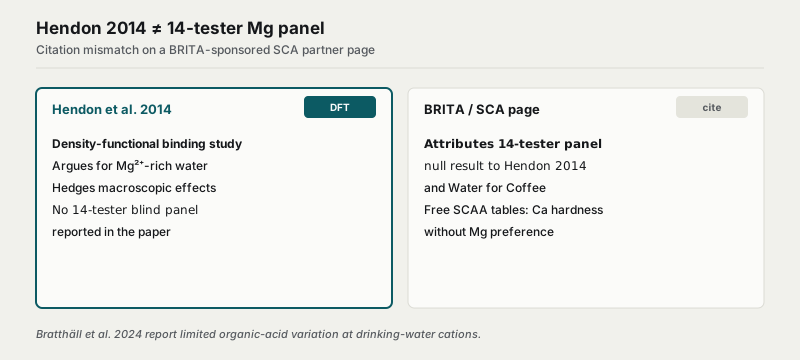
Free SCAA/SCA brewing-water tables publish calcium hardness without a magnesium preference; Hendon et al. 2014 is a density-functional binding study that argues for Mg²⁺-rich water for yield while hedging macroscopic effects and never reports a 14-tester blind panel; and a BRITA-sponsored SCA partner page attributes that panel null to Hendon 2014 and Water for Coffee, while Bratthäll et al. 2024 report limited organic-acid variation at drinking-water cation concentrations.
“Magnesium extracts better than calcium” often travels as settled specialty-coffee water science, sometimes with a sensory null or a computational paper attached as if they were the same kind of evidence. In the free and open-access sources below, those attachments do not hold together. The free SCAA/SCA brewing-water tables name calcium hardness and do not publish a magnesium preference. Hendon, Colonna-Dashwood, and Colonna-Dashwood 2014 is a density-functional-theory binding-energy paper that argues for magnesium-rich water for extraction yield, hedges macroscopic sensory effects, and contains no 14-tester blind panel. A BRITA-sponsored page hosted in SCA’s “News from Our Partners” channel states that a theoretically better magnesium extraction “went unrecognized by 14 testers in a blind taste test” and cites that paper together with the unpaid book Water for Coffee. Bratthäll, Figueira, and Nording 2024, an open-access GC-MS/NMR study of organic acids, reports limited acid-content variation at drinking-water cation concentrations — a different method again.
What matters is which source carries which magnesium claim, under which method, and where a later partner page attaches a sensory-panel sentence to a paper that does not report one.
Four documents, four magnesium roles
| Role | Source | What that document actually carries about magnesium |
|---|---|---|
| Free brewing-water characteristic table | SCAA Water for Brewing Specialty Coffee (21 Nov 2009); repeated in SCA Coffee Standards (2018) §4.1 | Calcium Hardness target 68 mg/L / range 17–85 mg/L; no magnesium row, target, or preference |
| Computational cation-binding study | Hendon, Colonna-Dashwood & Colonna-Dashwood, J. Agric. Food Chem. 62, 4947–4950 (2014) | DFT relative binding energies; Mg²⁺-rich water “paramount if increasing extraction yield is important”; macroscopic flavor effects “would be better probed experimentally”; undesirable acids caveat; no blind panel |
| Sponsored partner summary | SCA “Water and the Taste of Coffee” (BRITA sponsored; Wayback capture 17 Dec 2022 of a page dated 1 Feb 2020) | States a theoretically better magnesium extraction “went unrecognized by 14 testers in a blind taste test,” citing sources (5) and (4) — Hendon 2014 and Water for Coffee |
| Experimental organic-acid study | Bratthäll, Figueira & Nording, Heliyon 10, e26625 (2024) | Pre- and post-brew Ca/Mg chloride additions; “limited variation of the acid content” at drinking-water concentrations; not a 14-tester sensory panel |
Those rows are not interchangeable. A calcium-hardness table is not a magnesium preference. A binding-energy calculation is not a blind taste test. A partner-page sensory sentence is not validated by naming a computational paper. An acid-extraction experiment is not the free brewing-water table.
What the free tables publish — and do not
The 2009 SCAA one-page standard publishes, among other rows, Calcium Hardness at a target of 4 grains or 68 mg/L and an acceptable range of 1–5 grains or 17–85 mg/L. SCA Coffee Standards (2018) §4.1 reprints that table. Neither free document contains a magnesium characteristic, a magnesium target, or a statement that magnesium is preferred to calcium for extraction or flavor.
A separate article on the free SCAA brewing-water tables examines whether those free tables show a derivation of the familiar 150/68/40 triad. This article does not repeat that provenance check. It only needs the published hardness label: calcium, not magnesium.
What Hendon 2014 actually is
Hendon et al. 2014 states its method in the abstract: “Using density functional theory, we quantify the thermodynamic binding energies” of selected coffee acids, caffeine, and eugenol. The Materials and Methods section describes quantum-chemical calculations in FHI-aims with the PBE functional. That is a computational binding study, not a cupping panel.
On magnesium specifically, the paper is not silent and is not a sensory null. It states that “Mg²⁺-rich water is paramount if increasing extraction yield is important,” then immediately hedges that a modest relative preference for desirable acids over undesirable ones “would be better probed experimentally.” It also states that the high binding energies of the undesirable acids (quinic and chlorogenic) are “less pleasing” and that, relative to other ions, Mg²⁺ “would significantly increase the extraction of these compounds.” Later it offers a “compelling argument” for exchanging Ca²⁺ for Mg²⁺ “to increase extraction yield, with no deficit to coffee flavor,” plus a scale-formation benefit. Those are the paper’s own computational conclusions and hedges. They are not a report that fourteen tasters failed to detect a magnesium effect.
A full-text check of the publisher PDF finds no occurrence of “blind,” “tester,” “testers,” “panel,” or “sensory” as a method description for a human tasting. The paper’s uses of “taste” are ordinary flavor vocabulary (for example, that chlorogenic acid is considered to taste pungent), not a panel protocol. Whatever else may exist in unread books or unpublished panels, this JAFC article does not itself report a 14-tester blind taste test.
What the BRITA SCA partner page attaches
The source used here is SCA’s “Water and the Taste of Coffee” page in the “News from Our Partners” channel, labeled “Sponsored content provided by BRITA,” and carrying an SCA Staff date of 1 February 2020. The live URL returned 404 when checked; the claims below are scoped to the Wayback Machine capture dated 17 December 2022 (20221217062512).
In the minerals section, after discussing alkalinity and hydrogen carbonate, the page states:
Other minerals such as sodium, magnesium, and calcium play a more minor role in terms of the taste of coffee. Certain studies have recently examined this topic, but a theoretically better extraction through a greater proportion of magnesium in the drinking water went unrecognized by 14 testers in a blind taste test (5) (4).
Its Sources list identifies:
- (4) M. Colonna-Dashwood, C. Hendon, Water for Coffee, Bath, United Kingdom: Colonna and Small’s, 2015.
- (5) “The Role of Dissolved Cations in Coffee Extraction,” C. Hedon [sic], L. Colonna-Dashwood, M. Colonna-Dashwood, Journal of Agricultural and Food Chemistry 62, 4947–4950 (2014).
So the partner page’s 14-tester sentence is explicitly footnoted to Hendon 2014 and to Water for Coffee. Against the JAFC PDF, the Hendon half of that citation pair cannot carry the panel claim: the paper is DFT binding energies and does not report fourteen blind testers. Water for Coffee is outside the sources used here, so this check does not say whether the book contains that panel. It says that one of the two cited carriers — the open peer-reviewed paper — does not, and that the partner page’s wording presents the panel as if those citations support it.
The page is also a different publication class from an SCA standard. It is sponsored partner content on an SCA news URL, not the free Water for Brewing Cover + 1 table and not SCA Standard 310.
What Bratthäll et al. 2024 adds without closing the citation gap
Bratthäll, Figueira, and Nording, Heliyon 10, e26625 (2024), add magnesium and calcium chloride pre- and post-brew and measure citric, malic, lactic, and quinic acids by GC-MS and NMR. Their abstract states that at concentrations typically found in drinking water the salts produced “limited variation of the acid content,” while ten-fold higher concentrations produced more pronounced variations, and that similar pre- and post-brew acid contents suggest “extraction of acids proceeds independent of the water composition,” with post-brew interactions still possibly affecting perceived flavor. The introduction cites Hendon et al. as computational modeling suggesting that divalent cations increase extraction of flavor compounds such as organic acids.
That paper is usable here as a dated experimental result about measured organic acids under stated salt additions. It is not a 14-tester sensory panel, it does not validate the BRITA page’s citation of Hendon for such a panel, and this article does not treat its acid measurements as a taste ranking or a water recipe.
Citation gap, not a mineralisation verdict
Across these sources, magnesium preference is not one published attachment. The free SCAA/SCA brewing-water tables state calcium hardness without a magnesium preference. Hendon 2014 is a DFT binding-energy argument for magnesium-rich water for yield, with experimental and undesirable-acid hedges, and without a 14-tester blind panel. A BRITA-sponsored SCA partner page attributes a 14-tester sensory null to Hendon 2014 and Water for Coffee; the JAFC paper does not report that panel. Bratthäll et al. 2024 report limited organic-acid variation at drinking-water cation concentrations under a different method again.
None of that proves magnesium never affects coffee flavor, or that no 14-tester panel exists in any unread document. It does not open Water for Coffee (2015), which is outside the sources used here. The live SCA partner URL returned 404 when checked; the evidence used here is the 17 December 2022 Wayback capture of a 1 February 2020 partner post. No mineralisation recipe, magnesium-versus-calcium brew target, or machine-water hardness band follows. Separate articles already cover what the free SCAA/SCA brewing-water tables cite, SCA 310’s home-brewer test-water summary, and La Marzocco versus Simonelli USA hardness bands.
Sources
References
Every source this article draws on, with a link or identifier a reader can follow to check it directly.
- Specialty Coffee Association of America, SCAA Standard | Water for Brewing Specialty Coffee, WATER_STANDARD VERSION 21NOV2009A, revised 21 November 2009. Public mirror: https://www.urbansaqua.com/wp-content/uploads/2023/09/www.urbansaqua.com-robust-ro-drinking-water-systems-water-standards.pdf
- Specialty Coffee Association, Coffee Standards, revised 2018, §4.1. Public mirror: https://editordecafe.com/wp-content/uploads/2019/03/6ec09-coffeestandards-digital.pdf
- Hendon, C.H., Colonna-Dashwood, L., and Colonna-Dashwood, M., “The Role of Dissolved Cations in Coffee Extraction,” Journal of Agricultural and Food Chemistry 62(21), 4947–4950 (2014). DOI 10.1021/jf501687c. Version of record: https://purehost.bath.ac.uk/ws/files/59229026/jafc_2014.pdf
- Specialty Coffee Association / BRITA, “Water and the Taste of Coffee,” News from Our Partners, SCA Staff date 1 February 2020. Wayback capture 17 December 2022: https://web.archive.org/web/20221217062512/https://sca.coffee/sca-news/news-from-our-partners/water-and-the-taste-of-coffee. Original URL (returned 404 when checked): https://sca.coffee/sca-news/news-from-our-partners/water-and-the-taste-of-coffee
- Bratthäll, T., Figueira, J., and Nording, M.L., “Influence of divalent cations on the extraction of organic acids in coffee determined by GC-MS and NMR,” Heliyon 10(5), e26625 (2024). DOI 10.1016/j.heliyon.2024.e26625. PMC PMC10907646
- Colonna-Dashwood, M., and Hendon, C., Water for Coffee, Colonna and Small’s, Bath, 2015. Cited from the BRITA/SCA partner page’s source list only; full text not used here.