1Zpresso’s microns per click are burr travel, not particle size
What this article adds
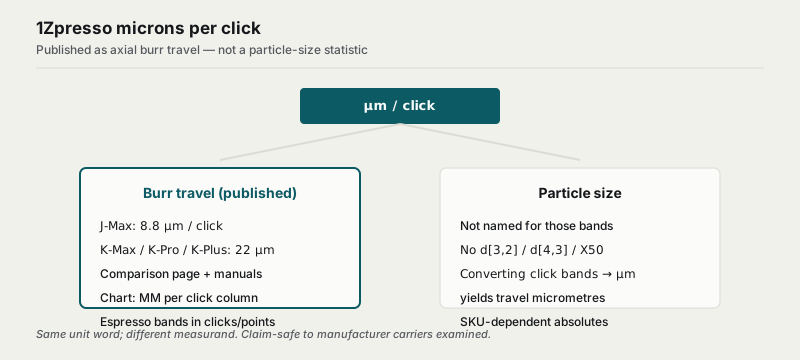
1Zpresso’s manuals and comparison page attach microns per click to axial burr travel (8.8 µm on J-Max; 22 µm on K-Max / K-Pro / K-Plus), while the manufacturer’s Coffee Grind Size Chart tabulates those increments under MM per click and prints espresso reference bands in clicks or dial points — so converting those espresso bands yields different absolute micrometres of burr travel across those SKUs, and none of those carriers name a particle-size statistic for those bands.
A micron figure next to a coffee grinder is incomplete until the role is named: particle-size summary, burr gap / axial travel, dial travel per click, or something else. 1Zpresso’s own materials force that naming. The manufacturer page is titled a coffee grind size chart and talks about microns per click. The manuals below say those microns are how far each click moves the burr. The espresso brew-method charts then publish bands in clicks or dial points, not in particle-size micrometres.
This is not a dial-in guide and not a ranking of hand grinders. It reconciles what the 1Zpresso carriers below attach the micrometre unit to, scoped to espresso rows on those charts.
Microns per click: burr travel in the manuals
The J-Max English manual states: “90 clicks in a single rotation and each click moves the burr by 0.0088mm/8.8 microns.” The K-Pro / K-Plus / K-Max / ZP6 Special English manual states the same role with a different increment: “90 clicks per full rotation” and “each click moving the burr by 0.022mm (22 microns).” That K-series manual also describes turning the dial clockwise to a coarser setting as “increasing the gap inside,” which keeps the micrometre figure on the axial gap / burr-travel side of the comparison rather than on a named particle-size mean.
The K-Max vs. J-Max comparison page repeats both increments in the same words: K-Max “90 clicks per rotation, 10 clicks per number, 22 microns per click”; J-Max “90 clicks per rotation, 10 clicks per number, 8.8 microns per click.” So across three manufacturer carriers, the micrometre unit is attached to travel per click, and the two espresso-capable external-adjustment lines do not share one travel increment.
The grind-size page: MM per click, charts in clicks and points
The page Coffee Grind Size Chart for 1Zpresso Manual Coffee Grinder (dated 20 October 2020 on the page) publishes an adjustment table whose final column is headed MM per click. For the rows used here it prints 0.0088mm for J-Max S and 0.022mm for K-Plus / K-Pro / K-Max / ZP6 Special — the same numbers the manuals attach to burr movement. Immediately under that table the page prose switches unit labels and says users can differentiate models by “microns per click.” On this carrier, MM per click and microns per click are the same dial-travel column, not a second, particle-size column.
The same page then gives worked examples of grind settings as rotations, numbers, and clicks from a zero point. It does not, in the text, convert those espresso-adjacent examples into a d[3,2], d[4,3], X50, or other particle-size statistic.
The espresso bands themselves appear on the manufacturer grind-setting reference graphics linked from that page family:
| Carrier | Espresso band on the chart | Unit printed on that chart |
|---|---|---|
| J-Max Grind Setting Reference (filename dated 20220721) | from the labeled 90 click mark to the labeled 150 click mark | clicks (also rotations / numbers) |
| K-Pro/K-Max/K-Plus Grind Setting Reference (filename dated 211129; matching manufacturer PDF) | green Espresso bar from about Point 3.1 to about Point 4.6 on the labeled Point scale | dial points (10 clicks per whole number on the same page’s table) |
The J-Max graphic also prints “For reference only. Please adjust depending on the flavor you like.” Neither espresso bar is labeled in micrometres of particle size.
Conditional arithmetic: one espresso band is not one µm of travel
Using only the manufacturer travel increments and the espresso bands:
| Model line | Espresso band | µm per click (manufacturer) | Burr travel from zero if each click is the printed travel |
|---|---|---|---|
| J-Max | 90–150 clicks | 8.8 | 792–1 320 µm |
| K-Max / K-Pro / K-Plus | ≈31–46 clicks (Point 3.1–4.6 × 10 clicks/number) | 22 | ≈682–1 012 µm |
Those intervals overlap, but they are not the same band, and neither interval is printed on the charts as a particle diameter. The arithmetic only multiplies the click/point band by the travel-per-click figure. It does not establish that grounds leaving the burrs have that mean size, and it does not rank the grinders.
What the carriers do establish is narrower:
- The micrometre unit in “8.8 microns” / “22 microns” / “microns per click” is attached to burr travel per click.
- The espresso reference bands are published in clicks (J-Max) or dial points (K-series), not as particle-size micrometres.
- Converting those espresso bands with the printed travel increments does not yield one absolute micrometre-of-travel figure across the J-Max and K-series lines.
Limits
- K-series espresso endpoints are read from the chart geometry against OCR-located Point labels (about 3.1 to 4.6); they are not printed as “31–46 clicks” on the graphic. The J-Max 90 and 150 endpoints sit on labeled click marks.
- The manufacturer PDF of the K-series chart is image-based in the file; the matching JPG is the readable mirror for band placement. Later silent revisions of the HTML pages or charts are outside the scope of this article.
- Other brew-method bars on the same graphics are outside the scope of this article. The Q-series reference graphic on the grind-setting page does not carry an Espresso bar in the image and is not used here as a negative about espresso capability.
- Distinct from this site’s Mazzer ZM article: that reconciliation concerns manufacturer Recommended Range [μm] values that move with burr SKU on an indicative chart whose product pages define the setting as burr distance. The 1Zpresso finding here is that the µm figure is travel per click while the espresso bands are click/point ranges — a different split between roles.
Sources
References
Every source this article draws on, with a link or identifier a reader can follow to check it directly.
- 1Zpresso, Coffee Grind Size Chart for 1Zpresso Manual Coffee Grinder, https://1zpresso.coffee/grind-setting/
- 1Zpresso, User Manual – J-Max, https://1zpresso.coffee/manual-jmax-en/
- 1Zpresso, User Manual – K-Pro / K-Plus / K-Max / ZP6 Special, https://1zpresso.coffee/manual-k-en/
- 1Zpresso, K-Max vs. J-Max, https://1zpresso.coffee/kmax-vs-jmax/
- 1Zpresso, J-Max Grind Setting Reference (image; path dated 2022/07), https://1zpresso.coffee/wp-content/uploads/2022/07/J-Max-Grind-setting-reference-20220721.jpg
- 1Zpresso, K-Pro/K-Max/K-Plus Grind Setting Reference (image; path dated 2022/04, filename
211129), https://1zpresso.coffee/wp-content/uploads/2022/04/K-series-Grind-Setting-Reference-211129.jpg - 1Zpresso, K-Pro/K-Max/K-Plus Grind Setting Reference (PDF; path dated 2021/11), https://1zpresso.coffee/wp-content/uploads/2021/11/K-series-Grind-Setting-Reference-211129.pdf

