WBC espresso frees the dose while the volume line softens
What this article adds
The 2024–2026 World Barista Championship Official Rules keep competition espresso dose free and never state a mass brew ratio, while the beverage-volume definition softens from 30 mL ± 5 mL to “around 1 fl. oz. / 30 ml,” the technical shot-volume cue follows then disappears, and the 20–30 s recommendation is removed in 2026 — set against SCA 25 Magazine’s heritage SCAA block that attaches 7–9 g to a 25–35 ml band and a 20–30 s brew time, and against that magazine’s survey 1:2 as practice only.
Competition rules, heritage definitions, and café practice are often treated as if they shared one dose–yield–time attachment. In the World Barista Championship (WBC) Official Rules for 2024 through 2026, they do not. What follows is a process matrix of what those rulebooks attach to competition espresso — beverage volume, coffee dose, contact-time scoring, and the absence of a mass brew ratio — then places that matrix beside one heritage SCAA definition block and one practice-survey summary from the same SCA magazine article.
It does not prescribe a recipe, rank years, or convert millilitres into grams.
What three WBC rulebooks attach
| Kind of claim | 2024 Official Rules | 2025 Official Rules | 2026 Official Rules |
|---|---|---|---|
| Beverage-volume definition (§3.1.A) | “1 fl. oz. beverage (30mL +/- 5mL)” | “a beverage (around 1 fl. oz. / 30 ml)” | Same soft “around 1 fl. oz. / 30 ml” wording as 2025 |
| Coffee dose (§3.1.E) | “Espresso may be prepared with various amounts of coffee.” | Same free-dose sentence | Same free-dose sentence |
| Mass brew ratio in §3.1 | Not stated | Not stated | Not stated |
| Extraction-time scoring (§3.1.H) | Pair variance within 3.0 s mandatory for the Yes/No mark; “20-30 second extraction time is recommended, but not mandatory” | Same variance rule and same 20–30 s recommendation | Variance rule retained; recommended 20–30 s window removed |
| When the clock starts (§14.2.7) | “Extraction time begins when the competitor activates the machine’s brew cycle.” | Same start rule | Same start rule |
| Technical “should try” shot volume (§14.5.1) | “shot volume of 25-35 ml (30 ml +/- 5 ml)” | “shot volume of around 30 ml” | Shot-volume cue absent from the §14.5.1 station-management list |
Those rows are not interchangeable with a mass brew-ratio recipe. Across the three rulebooks, dose stays free. What moves is the hardness of the volume line, the presence of a recommended contact-time window, and whether station-management prose restates a numeric shot-volume target.
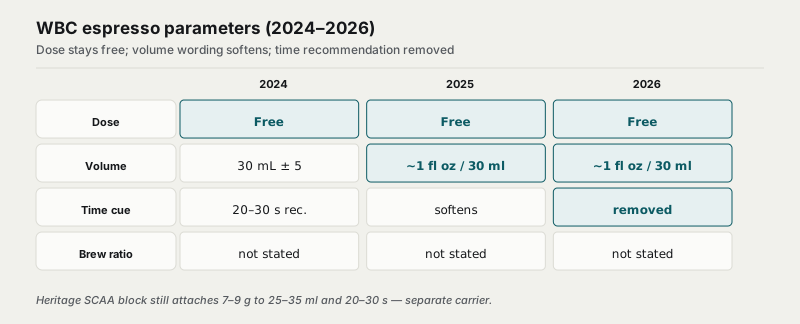
2024: hard ±5 mL volume, free dose
The 2024 World Barista Championship Official Rules and Regulations, written and approved by the WCE Rules and Regulations Committee and from the World Coffee Championships rules host, defines espresso for the competition as:
Espresso is a 1 fl. oz. beverage (30mL +/- 5mL) made from ground coffee, poured from 1 side of a double portafilter in 1 continuous extraction.
The same section states that if a served shot does not comply with that definition, taste and/or tactile scores reflect the resulting sensory experience, and immediately adds: “Espresso may be prepared with various amounts of coffee.” Volume is definitional; dose is expressly variable.
Contact time is scored for consistency, not for landing inside a fixed window. Extraction times between two pairs must fall within a 3.0-second variance or the technical “Extraction time” mark is “no.” Separately: “A 20-30 second extraction time is recommended, but not mandatory.” The technical procedure states that extraction time begins when the competitor activates the machine’s brew cycle — a published start point, not a sensory first-drop convention.
Under technical station management, competitors “should try to achieve extraction times within a 3.0 second variance and shot volume of 25-35 ml (30 ml +/- 5 ml).” That restates the definitional ±5 mL band as a “should try” cue. It is still volume, not beverage mass, and it is not paired with a required dose.
None of §3.1 states a coffee-to-beverage mass ratio.
2025: volume definition relaxes; dose stays free
The 2025 Official Rules keep the free-dose sentence and the 20–30 s recommendation, but change the definitional volume line to:
Espresso is a beverage (around 1 fl. oz. / 30 ml) made from ground coffee, poured from 1 side of a double portafilter in 1 continuous extraction.
The hard “30mL +/- 5mL” parenthetical is gone. The technical station-management cue moves in parallel: competitors “should try to achieve extraction times within a 3.0 second variance and shot volume of around 30 ml.”
The 2025 WBC Summary of Rule Changes prints the 2024 and 2025 §3.1.A sentences side by side and states: “The definition of espresso has been relaxed to allow competitors more freedom in their preparation.” That is the committee’s own framing of the edit. It does not attach a gram dose or a 1:2 mass ratio to the relaxed volume line.
2026: recommended time window removed; shot-volume cue gone from §14.5.1
The 2026 Official Rules keep the soft “around 1 fl. oz. / 30 ml” definition and the free-dose sentence. Section 3.1.H retains the 3.0-second pair-variance rule and no longer carries the “20-30 second extraction time is recommended, but not mandatory” sentence.
The 2026 WBC Summary of Rule Changes records that removal and states: “The recommended extraction time has been removed as it is not linked to the evaluation.” Consistency between pairs remains the scored contact-time claim; a recommended absolute window does not.
In the 2026 §14.5.1 station-management list, the former “should try … shot volume …” sentence is absent. Extraction-time start at brew-cycle activation remains in §14.2.7. Dose remains “various amounts of coffee.” A mass brew ratio is still not a §3.1 requirement.
Machine brewing temperature (90.5–96 °C setpoint) and pump pressure (8.5–9.5 bar) are competition equipment settings in these rulebooks. They are not used here to adjudicate café brew-slurry temperature claims, and they do not supply dose or mass-ratio numbers.
Heritage SCAA dose attachment, and survey 1:2 as practice
SCA 25 Magazine Issue 3 (Fasman’s “Defining the Ever-Changing Espresso”) quotes a block labeled the “heritage” Specialty Coffee Association of America definition of espresso. That block attaches a gram dose and a 20–30 s brew time to a 25–35 ml beverage:
Espresso is a 25–35ml (.85–1.2 ounce [×2 for double]) beverage prepared from 7–9 grams (14–18 grams for a double) of coffee through which clean water of 195°–205°F (90.5°–96.1°C) has been forced at 9–10 atmospheres of pressure, and where the grind of the coffee is such that the brew time is 20–30 seconds…
Against the WBC matrix, three differences between roles matter for dose, yield, and time:
| Line | WBC 2024–2026 | Heritage SCAA block in 25 Magazine |
|---|---|---|
| Dose | “various amounts of coffee” | 7–9 g (14–18 g double) |
| Beverage volume | Hard ±5 mL (2024), then “around … 30 ml” (2025–2026) | 25–35 ml with ounce parenthetical |
| Contact time | Pair variance scored; absolute 20–30 s only a recommendation through 2025, removed in 2026 | Brew time stated as 20–30 seconds in the definitional sentence |
| Mass brew ratio | Not stated in §3.1 | Not stated in the heritage block |
The same magazine article then reports the March 2017 Barista Guild of America espresso survey (275 respondents). Among its published summaries: 82% measured yield by weight; average weighed output 36.5 g; average reported brew ratio 1:2 (example 20 g in / 40 g out; range 1:1.5–1:2.5); an 18–20 g average-dose band in the article’s summary language; 51% reported average extraction 25–30 s.
Those survey figures are practice summaries. They are not the WBC Official Rules, and they are not the heritage definition block. Collapsing “average reported ratio 1:2” into “competition espresso is 1:2” or into “the heritage definition is 1:2” is the role error this matrix is built to prevent. A separate article already reconciles that heritage block with a 2001 SCAA preparation page; this piece does not reopen that ounce-versus-gram dispute.
Free dose, softening volume, disappearing time cue
In the 2024–2026 WBC Official Rules, competition espresso keeps coffee dose free while the beverage-volume definition softens from 30 mL ± 5 mL to “around 1 fl. oz. / 30 ml,” the technical shot-volume cue follows that softening and then disappears from the 2026 §14.5.1 list, and the recommended 20–30 s window is removed in 2026 with an explicit summary note that it was not linked to evaluation. None of those §3.1 definitional passages states a mass brew ratio. The heritage SCAA block quoted in SCA 25 Magazine Issue 3 attaches 7–9 g and a 20–30 s brew time to a 25–35 ml beverage — a different dose/time attachment than WBC’s free-dose rules. The magazine’s 1:2 / 36.5 g averages are survey practice, not either rulebook’s requirement.
That matrix does not settle whether WBC volume is measured as beverage mass, whether “around 30 ml” has a hidden numeric tolerance, whether free dose means any yield is scored as compliant without sensory consequence, whether the heritage block is wrong, whether 1:2 is undocumented as practice, or whether café recipes should follow any one row. Those conclusions need measurements or documents this article does not claim.
Sources
References
Every source this article draws on, with a link or identifier a reader can follow to check it directly.
- World Coffee Events / World Coffee Championships, 2024 World Barista Championship Official Rules and Regulations — https://wcc.coffee/s/2024-World-Barista-Championship-Official-Rules-and-Regulations-lfer.pdf (listed on https://wcc.coffee/rules-regulations). Competition rules (beverage definition §3.1; extraction-time start §14.2.7; station-management shot-volume cue §14.5.1).
- World Coffee Championships, 2025 World Barista Championship Official Rules and Regulations — https://wcc.coffee/s/2025-World-Barista-Championship-Official-Rules-and-Regulations.pdf. Competition rules (softened volume definition; free dose; 20–30 s recommendation retained; “around 30 ml” technical cue).
- World Coffee Championships, 2026 World Barista Championship Official Rules and Regulations — https://wcc.coffee/s/2026-World-Barista-Championship-Official-Rules-and-Regulations.pdf. Competition rules (soft volume retained; free dose; recommended 20–30 s removed from §3.1.H; no shot-volume cue in §14.5.1 in the sources).
- World Coffee Championships, 2025 WBC Summary of Rule Changes — https://wcc.coffee/s/2025-WBC-Summary-of-Rule-Changes.pdf. Committee change note (states the espresso definition “has been relaxed”).
- World Coffee Championships, 2026 WBC Summary of Rule Changes — https://wcc.coffee/s/2026-WBC-Summary-of-Rule-Changes.pdf. Committee change note (states the recommended extraction time “has been removed as it is not linked to the evaluation”).
- David Fasman, “Defining the Ever-Changing Espresso,” 25 Magazine Issue 3, Specialty Coffee Association — https://sca.coffee/sca-news/25-magazine/issue-3/defining-ever-changing-espresso-25-magazine-issue-3-zyx36. Association magazine article (labeled “heritage” SCAA definition quotation; March 2017 BGA espresso survey summaries).