Where thirty pounds appears in the tamp record
What this article adds
A bounded six-source record separates six documentary roles for finishing-tamp force and shows where thirty pounds appears as a finishing target and a product calibration setpoint rather than as competition wording, a packing maximum, a patent preferred range, or a later scoped experiment.
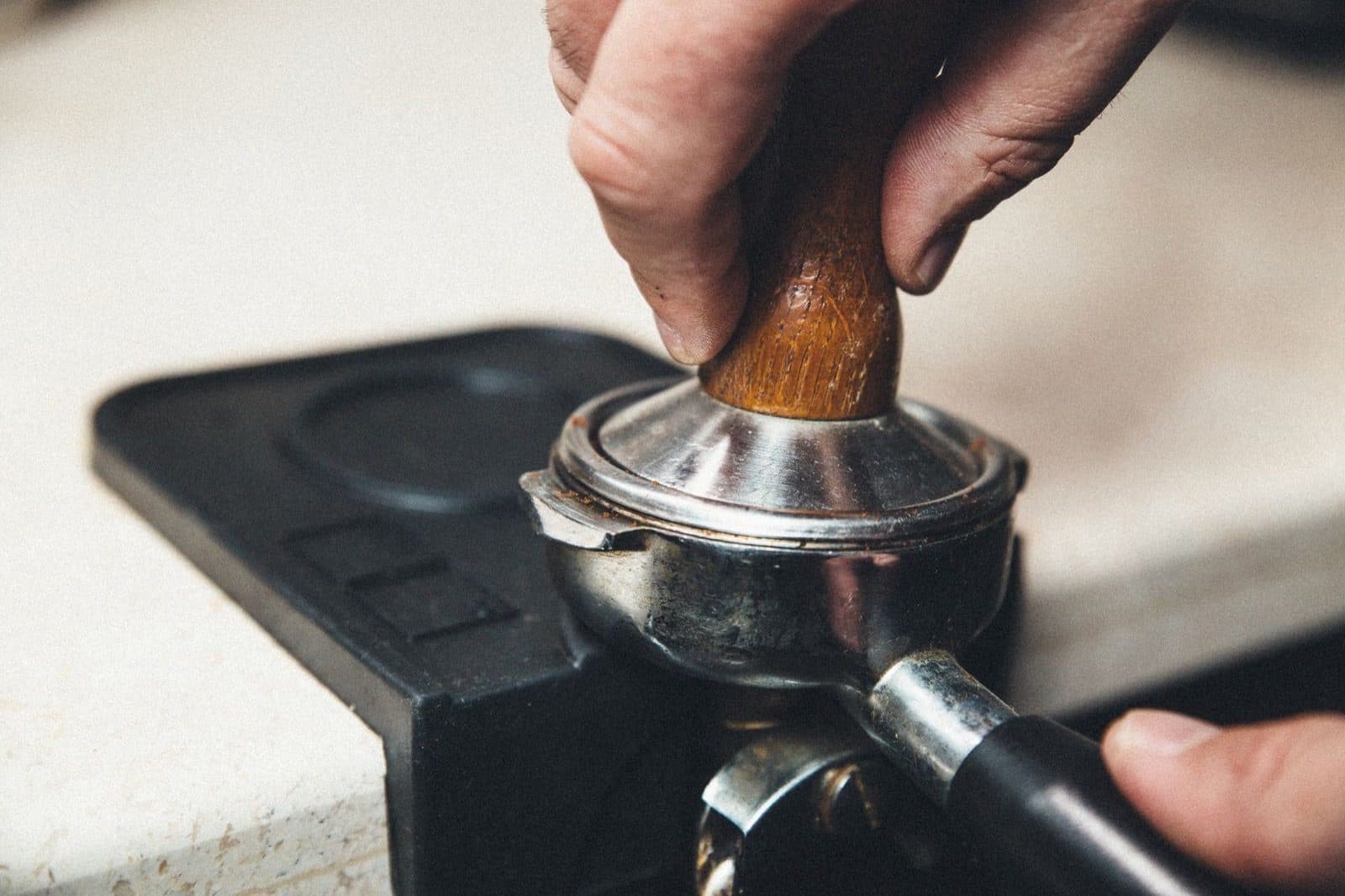
Thirty pounds of tamping force is one of espresso’s most repeated preparation numbers. Ask what document made it a target and the answers usually collapse several different roles into one figure. This article does not ask whether tamping pressure “matters.” It asks a narrower provenance question: in a fixed six-source record, where does thirty pounds actually appear, and what role each document is playing when a force number is or is not stated.
The useful finding is a process matrix, not a recipe.
Six roles in one bounded record
| Documentary role | Source | Force claim in that role |
|---|---|---|
| Finishing-tamp target | CoffeeResearch “Tamping,” Wayback capture 2002-02-02 | Finishing tamp at “thirty pounds of pressure”; first tamp at five pounds |
| Nonnumeric competition wording | SCAA “Preparation Standards,” Wayback capture 2001-03-03 | Tamp named only as managed with grind for about 25 ± 5 s extraction; no lb/kg force on that page |
| Maximum / packing instruction | Schomer, On The Table #18, revised 22 July 1999 | Forty pounds maximum packing force; polish with no more than twenty pounds |
| Patent preferred / optimal range | US 7,992,486 B2 (Espro calibrated tamper) | Commonly used forces preferably 5–100 lbf; optimally about 20–40 lbf; device not fixed at 30 lb in the patent text |
| Product factory calibration | Espro calibrated-tamper archive page, Wayback capture 2010-12-20 | “30 lb force feedback” / “30 pound force actuation, factory calibrated” |
| Later scoped experiment | Socratic Coffee blog, posted 28 Jul 2015, updated 30 May 2017 | Smart Tamp levels 5/10/15/20 kg; null on TDS, extraction yield, and brew time under that setup — not a 30 lb provenance source |
Those six roles are not interchangeable. Thirty pounds shows up in this record as a finishing target and later as a factory actuation setpoint. It does not show up as the SCAA page’s competition wording, as Schomer’s packing maximum, as the patent’s preferred band, or as the Socratic experiment’s tested levels. The SCAA preparation page is one row in that record.
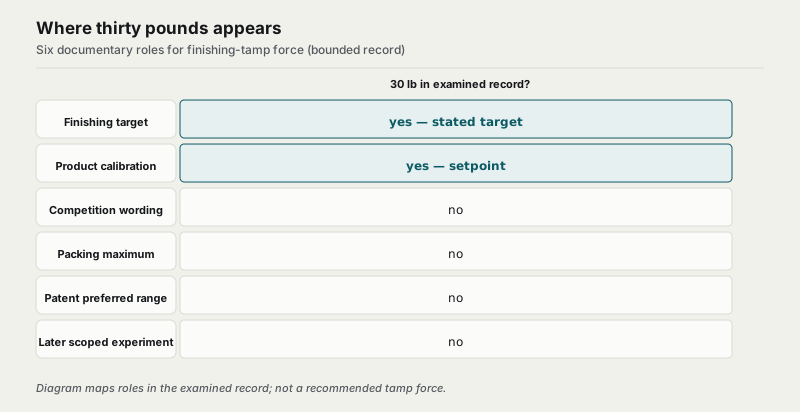
Finishing target: CoffeeResearch, earliest 30 lb here
The Coffee Research Institute page titled “Tamping,” from the Internet Archive capture dated 2 February 2002 (20020202164002), describes a gentle first tamp at five pounds, then a finishing tamp: “press on the pellet with thirty pounds of pressure.” That is a finishing-tamp target in instructional prose.
Two dating limits matter.
The page footer reads “© 2001. Coffee Research Institute.” Site copyright is not publication proof for that page’s text. The defensible date for this check is the Wayback capture of 2002-02-02.
Within this bounded six-source record, that capture is the earliest numeric thirty-pound finishing target in the sources. That is not a claim that CoffeeResearch originated thirty pounds globally, or that no earlier unreachable document exists.
Nonnumeric competition wording: the SCAA page
The SCAA “Preparation Standards” page from the 3 March 2001 Wayback capture (20010303183606) defines espresso for SCAA Barista Certification and World Championship contests. It says grind and tamp are “managed so that the extraction time is approximately 25 seconds (+/- 5 seconds).” That page names tamp in relation to approximate extraction time. It does not state a tamp force in pounds or kilograms.
That absence is scoped to the page. It is not a claim that SCAA never prescribed a numeric tamp force elsewhere.
Maximum, not target: Schomer 1999
David Schomer’s Lucidcafé column On The Table #18, “Espresso Packing Technique ’99,” is revised 22 July 1999. Under packing weight he settles on “40 pounds maximum pressure,” then instructs to “Bear down with forty pounds” on the second pack and to polish “with no more than twenty pounds of weight.” Closing the piece: “Pack straight down with forty pounds, polish with less than twenty pounds.”
Forty pounds is a maximum packing instruction in that column. Twenty pounds caps the polish stroke. Neither figure is a thirty-pound finishing target, and this article does not convert Schomer’s maximum into one.
Patent range: preferred band, not a 30 lb device fix
US 7,992,486 B2, “Calibrated handheld espresso tamper,” inventors Bruce Constantine and Christopher McLean, original assignee Espro Inc., carries Google Patents metadata of priority 18 December 2003 (related application US53050703P, filing date also listed as 18 December 2003), filing 17 December 2004 (US11/016,638), and grant / publication 9 August 2011. Patents establish disclosure and claim language on a date; they do not prove extraction optima.
In the description, indexed or selectively variable calibration magnitudes “may correspond to commonly used tamping force magnitudes for the preparation of espresso coffee, which preferably range between 5 to 100 lbs force, and optimally from about 20-40 lbs force.” Dependent claims likewise recite actuation between 5 and 100 lbf and between 20 and 40 lbf. The patent text does not fix the device at thirty pounds.
Among “Other References,” the patent cites Coffee Research Institute, “Tamping,” http://www.coffeeresearch.org/espresso/tamping.htm, accessed 26 November 2004, “posted 2001 or earlier,” and Schomer, D.C., a Lucidcafé Schomer’s Table URL for table 11, revised 24 October 1997. Those are the patent’s own bibliographic statements. The Schomer document examined for this article is On The Table #18 (1999), not the 1997 table-11 page the patent lists.
Product calibration: Espro’s factory 30 lb setpoint
The Espro calibrated-tamper product page from the 20 December 2010 Wayback capture (20101220153512) states the product role plainly: “30 lb force feedback from a tamper that looks and feels like an ordinary espresso tamper,” and under specifications, “30 pound force actuation, factory calibrated.”
That is a manufacturer calibration / force-feedback setpoint. It is not, on that page, an extraction-optimum claim, and this article does not promote the factory click as proof that thirty pounds is the best finishing force.
Later scoped experiment: what Socratic did and did not test
Socratic Coffee’s blog post “The Impact of Tamping Pressure on Espresso Extraction,” posted 28 July 2015 and updated 30 May 2017, is practitioner measurement on a blog, not a peer-reviewed journal article. Using Smart Tamp levels of 5, 10, 15, and 20 kg (the post’s own rounded labels: 12, 22, 32, and 42 lb), with n = 10 shots per level, a La Marzocco GS/3 MP at 9 bar and 92.5 °C, a Victoria Arduino Mythos One, a 20 g dose to about 40 g beverage mass, grind dialed at 15 kg then held fixed, and TDS from Atago PAL-COFFEE and VST LAB III instruments, the authors report no significant pressure effect on TDS (p = 0.40) and no significant effect on brew time to target weight (p = 0.30). When they substituted extraction yield for TDS, they report no significant differences for device, pressure condition, or their interaction (all p = 0.60+ regardless of which yield formula was used). The post does not report a power analysis.
That null is scoped to TDS, extraction yield, and brew time under that setup and force band. It is not a sensory result, not proof of zero effect outside those conditions, not a provenance source for thirty pounds, and not validation of a thirty-pound target. The post’s 5–20 kg band brackets about 11–44 lbf in kilogram-force terms; thirty pounds sits inside that band as a converted magnitude, not as a level the experiment was designed to authenticate.
Independent force conversions
Using 1 kgf = 9.80665 N = 2.2046226218 lbf and 1 lbf = 4.4482216153 N:
| Stated force | Exact conversion |
|---|---|
| 5 kgf | 49.033 N / 11.02 lbf |
| 10 kgf | 98.067 N / 22.05 lbf |
| 15 kgf | 147.100 N / 33.07 lbf |
| 20 kgf | 196.133 N / 44.09 lbf |
| 30 lbf | 133.45 N / 13.61 kgf |
Kilogram-force is not mass. The Socratic post’s rounded pound labels (12 / 22 / 32 / 42 lb) are approximate relative to these kilogram-force conversions.
What the matrix settles — and what it does not
In this six-source record, thirty pounds appears as CoffeeResearch’s finishing-tamp target in the earliest numeric finishing-target capture among these sources, and later as Espro’s factory actuation / force-feedback setpoint. Adjacent documents in the same record use different roles: nonnumeric competition timing language, a forty-pound maximum with a twenty-pound polish cap, a patent preferred band of about 20–40 lbf inside a broader 5–100 lbf range, and a 2015–2017 blog experiment whose null on TDS, yield, and time does not adjudicate the finishing-target figure.
This check does not establish a global origin for thirty pounds, does not say SCAA never used a numeric tamp force, does not turn Schomer’s maximum into a target, does not treat Espro calibration as an extraction optimum, and does not use Socratic as source or validation of thirty pounds. It also does not prescribe tamp technique or machine recipes.
Sources
References
Every source this article draws on, with a link or identifier a reader can follow to check it directly.
- Coffee Research Institute, “Tamping.” Internet Archive capture 2 February 2002 (
20020202164002) ofhttp://coffeeresearch.org/espresso/tamping.htm— https://web.archive.org/web/20020202164002id_/http://coffeeresearch.org:80/espresso/tamping.htm. Historical evidence (archived instructional page); footer © 2001 is site copyright, not publication proof for this check. - Specialty Coffee Association of America, “Preparation Standards.” Internet Archive capture 3 March 2001 (
20010303183606) ofhttp://scaa.org/barista/standards.html— https://web.archive.org/web/20010303183606id_/http://scaa.org:80/barista/standards.html. Historical evidence (archived competition / certification standards page). - David C. Schomer, “On The Table #18: Espresso Packing Technique ’99,” Lucidcafé / Espresso Vivace archive PDF, revised 22 July 1999 — https://espressovivace.com/archives/lucidcafe/LC18.pdf. Practitioner observation (dated trade column).
- Constantine, B., and McLean, C., “Calibrated handheld espresso tamper,” US 7,992,486 B2, priority 18 December 2003, filed 17 December 2004, granted 9 August 2011 — https://patents.google.com/patent/US7992486B2/en. Patent record (disclosure and claims; not extraction proof).
- Espro Inc., calibrated tamper product page. Internet Archive capture 20 December 2010 (
20101220153512) ofhttp://espro.squarespace.com/tamper/— https://web.archive.org/web/20101220153512id_/http://espro.squarespace.com/tamper/. Manufacturer / product archive (factory calibration and marketing copy). - Socratic Coffee, “The Impact of Tamping Pressure on Espresso Extraction,” posted 28 July 2015, updated 30 May 2017 — http://socraticcoffee.com/2015/07/the-impact-of-tamping-pressure-on-espresso-extraction/. Practitioner observation (blog experiment; not peer-reviewed journal).