124°C at 1.25 bar is not the same steam-boiler pair as 120°C at 1.2 bar
What this article adds
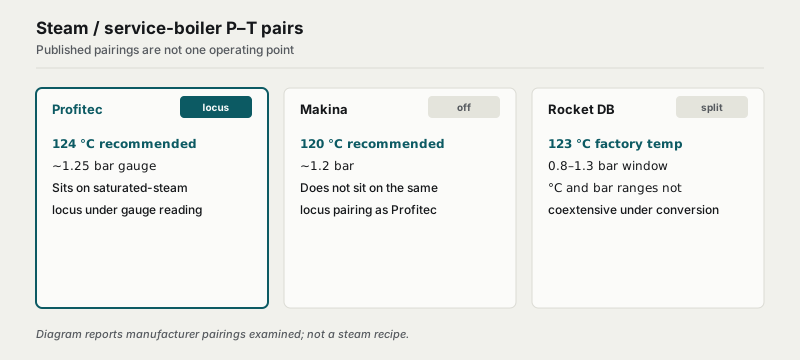
Manufacturer steam/service-boiler pairings of PID-displayed temperature with boiler-gauge pressure sit beside each other and beside the saturated-steam locus: Profitec’s recommended 124°C at about 1.25 bar sits on that locus under a gauge reading; Makina’s recommended 120°C at about 1.2 bar does not; Rocket’s dual-boiler service boiler publishes both a 123°C factory temperature and a separate 0.8–1.3 bar pressure window whose °C and bar ranges are not coextensive under the same conversion.
Heat-exchanger and dual-boiler manuals often treat a boiler PID reading in Celsius and a boiler manometer reading in bar as two names for the same ready state. On a saturated steam boiler that would be legitimate only if the published pair sits on the vapour-pressure curve. The manuals below do not all do that, and they do not all publish the same pair.
What follows is about those steam/service-boiler temperature–pressure pairings. It is not a re-run of this site’s separate HX article on brew/outlet attachments at a shared 120°C display.
What the saturation curve requires
A boiler that contains liquid water and steam at equilibrium has one pressure for each temperature. Espresso boiler gauges are read as gauge pressure (above atmosphere). Converting with standard atmospheric pressure 1.01325 bar, the IAPWS vapour-pressure relation used by the NIST Chemistry WebBook gives, among other points:
| Boiler temperature | Absolute saturation pressure | Gauge pressure (abs − 1.01325 bar) |
|---|---|---|
| 120°C | 1.987 bar | 0.97 bar |
| 123°C | 2.183 bar | 1.17 bar |
| 124°C | 2.252 bar | 1.24 bar |
Inverting the same relation: about 1.20 bar gauge corresponds to about 123.4°C; about 1.25 bar gauge to about 124.2°C. Those figures are the locus against which the manufacturer pairs below are read. They are not machine measurements.
Profitec’s recommended pair sits on the locus
A dealer-hosted Profitec Pro 500 user manual (English translation of the German original; Hommel PDF mirror) states that the PID regulates “the steam temperature and thus the boiler pressure,” with steaming temperature factory pre-set to 120°C. For heat-up it treats “approx. 1.0–1.25 bar” on the boiler pressure gauge and “120°C” / the preset PID temperature as alternative ready conditions.
In the PID programming section that same revision prints a single recommended pair:
We recommend a temperature setting on the PID of 124°C at about 1.25 bar, which corresponds to an outlet temperature of about 94°C (121°F).
Technically it allows 120–127°C on the PID. Against the saturation table above, 124°C and about 1.25 bar gauge are the same claim within ordinary rounding: the locus expects about 1.24 bar at 124°C and about 124.2°C at 1.25 bar. Profitec’s recommended steam-boiler pair is therefore thermodynamically coherent under a gauge reading.
A second Pro 500 PID manual revision (Whole Latte Love-hosted) keeps the factory 120°C preset and the 1.0–1.25 bar ready band, but presents a recommended display interval of 116–124°C with a brew-group extraction-temperature table rather than the single “124°C at about 1.25 bar” sentence. At its 120.0°C display row that table lists 93.4°C extraction temperature at the brew group. That is a brew-side attachment for a steam-boiler setpoint, not a second pressure pairing; it is noted only to mark that Profitec’s own revisions do not phrase the steam-side recommendation identically.
Makina’s recommended pair does not
Makina’s S7 Pro PID user manual uses the same ready-band pattern—“approx. 1.0–1.3 bar or a temperature of 120°C”—and then recommends:
We recommend a temperature setting on the PID of 120°C at about 1.2 bar, which corresponds to an outlet temperature of about 91°C.
If both numbers are meant as one saturated state under a gauge reading, they disagree with the locus: 120°C belongs with about 0.97 bar, and about 1.2 bar belongs with about 123.4°C. The sentence equates figures that saturation keeps about three degrees / a quarter-bar apart. Makina’s “about” wording already softens the claim; it does not erase the mismatch with Profitec’s coherent 124°C / 1.25 bar pair, nor with the vapour-pressure curve.
The outlet figures attached in those sentences (about 94°C versus about 91°C) are different attachments again — brew/outlet language—and are already the subject of this site’s HX brew-temperature article where Rocket’s Scace table is in play. They are not re-adjudicated here.
Rocket publishes temperature and pressure windows for one service boiler
Rocket Espresso’s English instruction manual, in the R 58 / R 60V dual-boiler programming section, factory-sets the service boiler (steam and hot water) to 123°C and allows 110–126°C. Separately, under the heading “TO CHANGE THE SERVICE BOILER PRESSURE,” the same section lets the user set “service boiler pressure” between 0.8 and 1.3 bar.
On the saturation locus those two windows are not the same adjustable range:
| Published Rocket service-boiler window | Approximate saturated partner under gauge conversion |
|---|---|
| Temperature 110–126°C | about 0.42–1.38 bar |
| Pressure 0.8–1.3 bar | about 117–125°C |
The factory 123°C line sits near 1.17 bar—inside the pressure window. The temperature window’s low end (110°C ≈ 0.42 bar gauge) lies well below the pressure window’s floor. Nothing in the pages states that the pressure menu is merely a unit conversion of the temperature menu, and nothing cites the vapour-pressure curve. What the document does establish is that one service boiler is described with both a Celsius factory setpoint/range and a bar adjustment range that saturation does not make coextensive.
Elsewhere in the same PDF, non-dual-boiler machines are told only that “Boiler pressure should be around 1 bar when machine is ready,” with no paired Celsius figure in that sentence. Around 1 bar gauge is about 120°C on the locus—consistent with the HX PID display band Rocket prints elsewhere, and a thinner claim than Makina’s or Profitec’s explicit °C-and-bar recommendations.
Putting the pairs beside the locus
In the Profitec Pro 500 Hommel-hosted revision, the recommended steam-boiler pair 124°C at about 1.25 bar matches the saturated-steam locus under a gauge reading. In the Makina S7 Pro PID manual, the recommended pair 120°C at about 1.2 bar does not. In the Rocket R 58 / R 60V section, a 123°C service-boiler factory temperature coexists with a 0.8–1.3 bar service-boiler pressure adjustment whose range is not the saturation partner of the published 110–126°C temperature band. Ready-state language that offers “about 1.0–1.25 bar or 120°C” (Profitec) or “about 1.0–1.3 bar or 120°C” (Makina) treats bar and Celsius as substitutes without always giving a thermodynamically matching pair.
None of that proves any of these gauges is accurate, that every HX PID uses these numbers, that brew/outlet temperature follows from steam-boiler saturation alone, or that one manufacturer’s recommendation is the field standard. Absolute-pressure (bara) readings would move every gauge comparison by about one atmosphere and are not what these domestic boiler manometers are written as. Sensor placement, pressurestat hysteresis, and PID tuning can separate a displayed temperature from the gauge even when the boiler is saturated; these manuals do not quantify that offset.
No flush recipe, milk-steam procedure, or purchase ranking follows. The documents disagree on which Celsius and bar figures name one steam-boiler state.
Sources
References
Every source this article draws on, with a link or identifier a reader can follow to check it directly.
- PROFITEC, Pro 500 user manual (English translation of the German original), dealer-hosted Hommel PDF — https://hommel-kaffeesysteme.de/wp-content/uploads/ba-pro500-1.pdf. Cited for factory steaming temperature 120°C; ready condition approx. 1.0–1.25 bar or 120°C / preset PID; technical PID range 120–127°C; and the recommendation “124°C at about 1.25 bar” with outlet about 94°C.
- PROFITEC, Pro 500 PID user manual (English), Whole Latte Love-hosted PDF — https://www.wholelattelove.com/cdn/shop/files/Pro_500_PID_User_Manual.pdf. Cited as a second revision for factory 120°C, the 1.0–1.25 bar ready band, recommended display interval 116–124°C, and the 120.0°C → 93.4°C brew-group extraction row in its measurement-series table.
- MAKINA, S7 Pro PID user manual — https://makinaespressomachines.com/app/uploads/2021/05/Makina-s7-Pro-PID-User-Manual.pdf. Cited for ready condition approx. 1.0–1.3 bar or 120°C, and §7.4 recommendation of PID 120°C at about 1.2 bar corresponding to about 91°C outlet.
- Rocket Espresso, user / instruction manual (English), dealer-hosted PDF at bean.ch — https://www.bean.ch/wp-content/uploads/Rocket_Instruction_Manual_EN_2019.pdf. Cited for R 58 / R 60V service-boiler factory 123°C and 110–126°C range; “TO CHANGE THE SERVICE BOILER PRESSURE” 0.8–1.3 bar; and the general “Boiler pressure should be around 1 bar when machine is ready” line on non-dual-boiler machine descriptions.
- NIST Chemistry WebBook, “Saturation Properties for Water” (NIST Standard Reference Database 69), citing Wagner and Pruß, J. Phys. Chem. Ref. Data 31, 387–535 (2002), DOI 10.1063/1.1461829 — https://webbook.nist.gov/chemistry/fluid/. Cited for the IAPWS vapour-pressure locus used to convert between saturated temperature and pressure; gauge values above assume subtraction of standard atmospheric pressure 1.01325 bar.